Key takeaways
- First-draft speed matters, but editability determines production value.
- A realistic test covers text, interactions, media, diagrams and assessments.
- Regulated teams need visible review time and manual work, not hidden polishing.
- A growing editable draft beats a polished one-off lesson.
The polished lesson is the wrong benchmark
In AI learning content tool evaluation, the polished lesson is the least useful artefact. It hides the real work. It shows output quality after unknown prompting, rewriting and design correction. It does not show whether the team can control the lesson once the first answer is wrong, incomplete or misaligned with policy.
Finance and crypto L&D teams rarely fail because a first draft looks rough. They fail because every policy change, product launch and control update creates a new content queue. If the learning stack turns each update into a mini project, AI course authoring only adds another layer of copy to manage.
The compliance context raises the bar. Article 4 of the EU AI Act requires AI literacy measures that reflect staff knowledge, role context and system risk. That is not solved by a beautiful slide. It needs a learning content workflow that can be reviewed, adapted and evidenced.
The real test starts with a rough concept
A useful AI instructional design workflow starts before generation. The team enters a rough concept, such as a new onboarding module on wallet risk, DORA incident routines or market abuse controls. The system should return a visible first draft with a clear lesson structure, not a sealed package. From there, editors should refine the didactic text, adjust examples, add interactions, request visual prompts and change assessment logic without breaking the structure.
- Start with one rough concept, not a perfect prompt.
- Show the first draft before polishing.
- Keep text, interactions, media and assessments editable.
- Track what humans changed and how long it took.
A serious test touches every layer
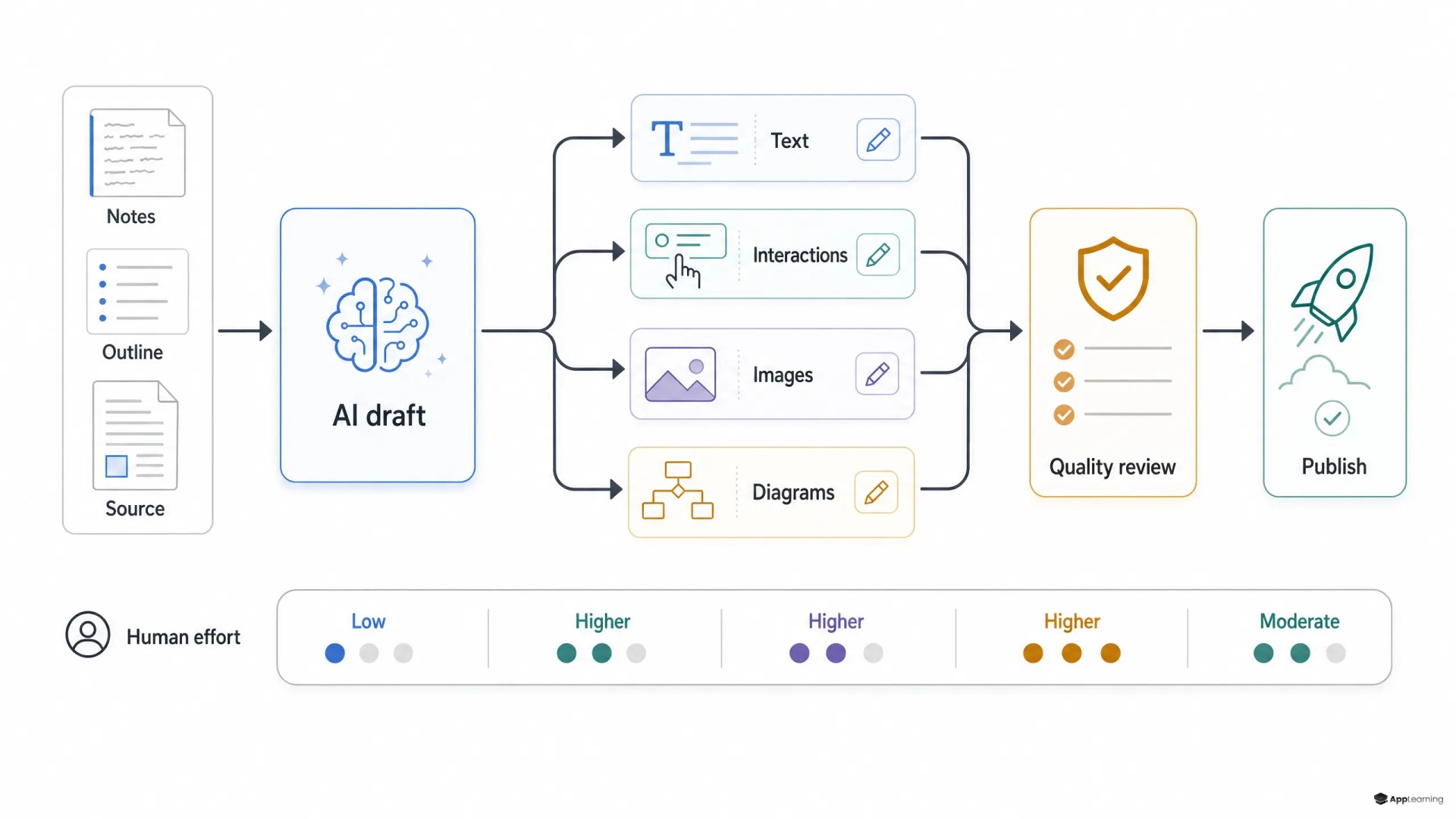
A realistic evaluation brief should force the system to produce more than paragraphs. The draft should contain short didactic text, one or two meaningful interactions per unit, useful image or prompt suggestions, technical diagrams where needed, and a mobile-ready one-page lesson format. This is where many tools break. They can write content, but they cannot preserve learning architecture while the team edits.
- Text that explains the policy in plain language.
- Interactions that test judgement, not recall only.
- Visual prompts that help a designer brief media work.
- Assessment logic that maps to the learning objective.
Good to know
How should an L&D team test an AI course authoring tool?
Start with a rough concept, inspect the first draft, edit it inside the tool, and measure correction time before publication.
Is a one-click generated course enough for compliance training?
No. Compliance learning needs expert review, clear assessment logic, evidence of changes and a format that can be updated when rules change.
Where does human review still matter?
Human review is essential for correctness, policy fit, risk framing, tone, examples, edge cases and final approval.
Speed without editability is noise
Time to first draft matters. It shows whether the system can reduce blank-page work. But speed is only one metric. The stronger measures are edit distance, correction time, factual error rate, interaction quality, media usefulness and the amount of manual work needed before publication. A tool that creates a decent lesson in two minutes but takes three hours to fix is not faster. It only moved the work out of sight.
- Speed from concept to first draft.
- Correctness after expert review.
- Ease of editing inside the same system.
- Manual work and review time before release.
This fits a broader AI governance principle. NIST AI RMF treats measurement and documentation as part of repeatable evaluation, not as decoration after deployment. Learning teams should apply the same discipline to AI-generated training content.
Turn your learning backlog into editable training.
TalkApp-Learning turns generation into production
At App-Learning, we treat AI learning content as a production environment, not a one-click generator. A concept becomes an editable lesson structure. Teams can work on text, interactions, visual prompts and assessment elements in the same flow. The point is not to remove human judgement. The point is to make human judgement visible, faster and better placed.
That matters in regulated companies because compliance training cannot become fragile content theatre. The useful artefact is a growing, editable draft that survives review and can be maintained when rules, products or risks change. The best AI content system is not the one that wins a demo. It is the one that makes the next version easier to produce than the last.