

Key takeaways
- AI authoring needs structured, accessible content models.
- APIs, permissions, tenancy, and versioning define the real workflow.
- Standalone generators often create new handoffs instead of removing them.
- Modernize content and AI authoring as one operating system.
The demo works until content meets the system
AI course generation looks strong in a demo. A prompt creates an outline. The model drafts a lesson, quiz, checklist, and manager guide. The problem starts when that output must enter the real learning stack: roles, branding, translations, academy paths, approvals, reporting, and reuse. If the platform only accepts finished pages or uploaded packages, the process turns back into copy and paste.
For a founder running a 50-plus person startup, this matters more than model quality. New hires need structured onboarding. Managers need consistent material. The company needs a central knowledge base that does not require a full L&D department. AI can help, but only if the learning content infrastructure can receive, edit, govern, and deliver what AI creates.
Better prompts cannot repair a rigid stack
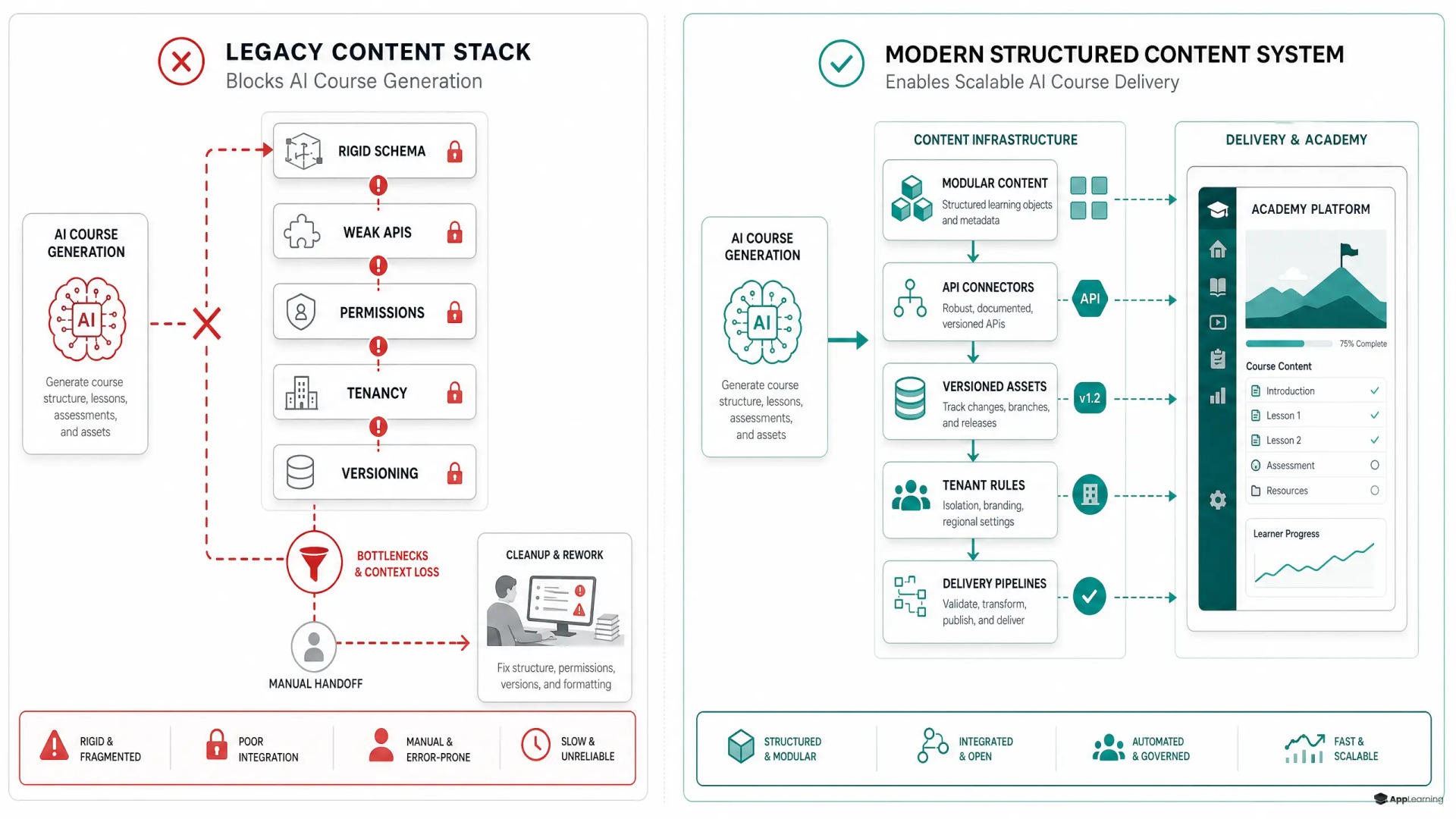
A better prompt can improve tone, examples, and quiz quality. It cannot add stable content IDs, a permission model, reusable modules, version history, or a clean API. If a policy paragraph lives inside ten cloned onboarding courses, AI cannot safely update it across every path without manual checking. If course structure is hidden inside static files, the model can generate text but not operate on the system.
This is the core issue in AI authoring architecture. The generator is only one component. The content model decides whether lessons can be reused. The API decides whether output can move. Permissions decide who can approve. Versioning decides whether teams can trust the result after the first draft.
AI authoring needs addressable content
Modern learning content should behave less like a document library and more like a structured product system. W3C’s Data on the Web Best Practices treat identifiers, metadata, versioning, and stable APIs as basic conditions for reuse. In a learning system, the same logic applies to modules, lessons, concepts, quiz items, role tasks, translations, and evidence of completion.
Interoperability standards show the same direction. 1EdTech’s Common Cartridge supports the movement of digital learning resources across learning platforms and repositories, while Learning Tools Interoperability defines patterns for connecting learning tools with platforms. A standalone generator that cannot publish into these boundaries is not automation. It is a writing aid with a manual delivery problem.
Tenancy permissions and versioning create the work
Fast-growing companies rarely need one course for one audience. They need a shared onboarding core with variants for roles, regions, teams, products, customers, and seniority levels. Legacy tenancy often solves this by cloning courses. That feels quick at first. Then every clone drifts. One compliance update becomes ten edits. One product change becomes a spreadsheet of affected lessons.
A multi-tenant content platform works differently. It separates shared content from local overrides: language, examples, branding, sequencing, enrollment rules, and permissions. AI can then generate a controlled variant instead of another orphan course. This is where legacy LMS modernization creates operating leverage, not just a cleaner interface.
Permissions and versioning are the trust layer. AI suggestions need states such as draft, review, approved, published, and retired. Editors need different rights from managers, academy owners, and tenant admins. In Europe, the AI Act framework reinforces the broader shift toward documentation, transparency, and human oversight for relevant AI systems. Even where internal onboarding is not a regulated AI use case, the operating pattern is useful: know what changed, why it changed, who approved it, and which learner saw which version.
Good to know
Do we need a new LMS to use AI authoring well?
Not always. If the existing LMS has usable APIs, roles, and delivery logic, it may be better to integrate AI authoring around it. If content is locked, duplicated, or impossible to version, the content layer needs modernization.
When is a headless CMS for LMS useful?
It helps when learning content must be reused across audiences, academies, languages, or products. The LMS can remain the delivery layer while structured content is managed separately.
What should a startup fix first?
Fix the content model before scaling generation. Define reusable modules, ownership, approval states, and delivery rules. Then AI can reduce work instead of creating more cleanup.
How much governance is enough for internal training?
Enough to know who changed content, who approved it, which version is live, and where it is used. That is the minimum trust layer for AI-supported onboarding.
Standalone generators can increase operations
The cheapest AI authoring tool is often the most expensive workflow. If generated content must be copied into an LMS, reformatted, mapped to roles, rechecked after review, translated outside the system, and tracked in another file, writing time has been saved but production work has increased. The team now has one more queue to manage.
This is common when AI is added as a feature rather than designed as part of the content layer. The output looks finished, but the organization still lacks a governed path from knowledge to course to academy experience. For founders, that means managers continue to carry onboarding quality on their own.
The content layer needs a deliberate path
The right move is not always a full rebuild. Start with the current content state, then choose the smallest architecture that removes the bottleneck.
- If the LMS has workable APIs and roles, embed an AI-assisted content studio into the existing workflow.
- If delivery works but content is locked, add a structured content layer or headless CMS for LMS use cases.
- If every audience requires a clone, redesign tenancy before generating more variants.
- If approvals are informal, build permissions and versioning before scaling AI output.
For most scaleups, the useful target is simple: one structured content model, one authoring workflow, one API boundary, and one academy surface where employees can actually learn. That is enough to professionalize onboarding without building an internal training department.
Build AI authoring on content that can scale.
TalkThe academy is the operating surface
At App-Learning, we treat AI-assisted course creation and academy delivery as one system. The work is not only prompt design. It is structuring content, defining permissions, connecting authoring to delivery, supporting multi-tenant academy experiences, and keeping the setup lean enough for growing teams.
AI will keep making first drafts cheaper. That does not remove the need for architecture. It makes architecture more important. The companies that benefit will not be the ones with the longest prompts. They will be the ones whose content can be edited, reused, governed, and shipped without rebuilding the workflow each time knowledge changes.