

Key takeaways
- Checklists guide movement, but they do not build product understanding by themselves.
- Complex products need onboarding that explains risk, value, timing, and consequences.
- In-app education works best when it appears at real moments of hesitation.
- Better onboarding metrics connect guidance, knowledge, behavior, and long-term activation.
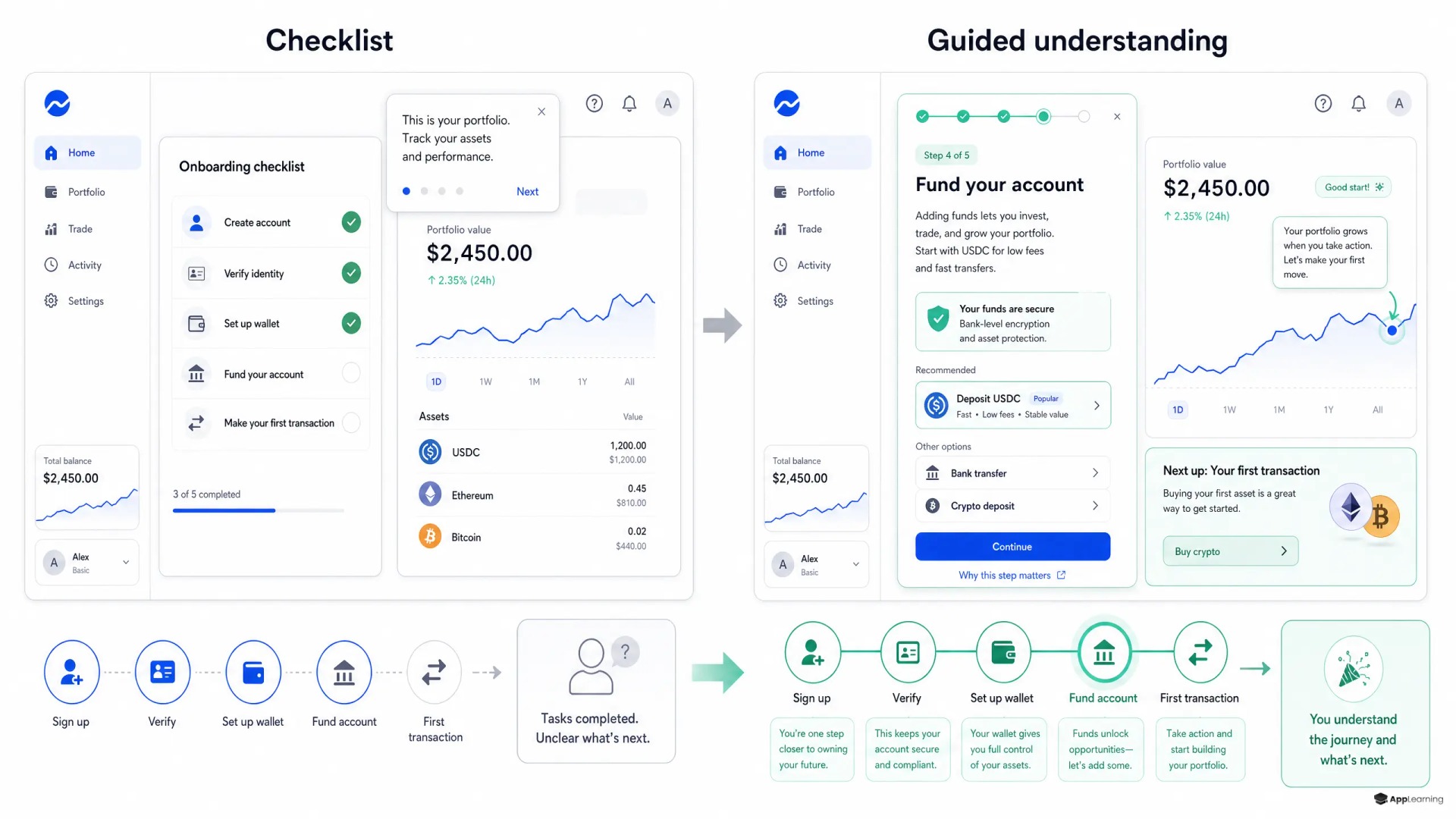
Most customer onboarding is built around movement. Show the next screen. Highlight the button. Add a checklist. Trigger a tour. This helps a user move through the interface, but it does not always help them understand the product well enough to act.
That gap matters most in complex categories. A Bitcoin app is not a note-taking app. A user may understand how to tap “buy” and still hesitate because they do not understand volatility, custody, recurring purchases, transaction finality, or why a savings plan exists. In that moment, the onboarding problem is not navigation. It is confidence.
Checklists solve movement, not meaning
Checklists are useful. They make progress visible. They reduce ambiguity. They turn a long onboarding journey into smaller actions. For a Bitcoin company, a checklist can help a user create an account, verify identity, add a payment method, make a first purchase, and enable a security feature.
Product tours also have a place. They can introduce a wallet tab, a recurring-buy screen, a transaction history, or a support entry point. They are especially helpful when the interface is new, the workflow is uncommon, or a feature has no familiar consumer pattern.
The problem starts when teams treat these patterns as onboarding itself. A checklist can confirm that a user reached the “set up savings plan” step. It cannot confirm that the user understands why recurring purchases may reduce timing anxiety, what fees apply, what happens if a payment fails, or how the plan relates to their own risk tolerance.
The shallow layer breaks in complex products
Surface guidance works when the product is simple and the user already believes in the outcome. It breaks when the user has to learn a concept before they can trust the action.
The Nielsen Norman Group describes mobile onboarding as more than teaching interface interaction; it can include setup, feature promotion, customization, and instructions across the user lifecycle. It also warns that many onboarding flows add interaction cost, strain memory, and may not improve task performance. That is the practical tension. More screens do not equal more understanding.
Bitcoin onboarding has several moments where interface orientation is not enough. KYC is not just a form. It raises privacy and trust questions. A first purchase is not just a payment action. It raises questions about price movement and timing. A wallet withdrawal is not just an address field. It raises questions about irreversible transactions, network fees, and responsibility.
If onboarding does not explain these moments, users either pause, leave, or contact support. Some may complete the flow but still fail to build the conviction needed for retention. That is a quieter problem because the dashboard may show activation while the user has not built the mental model to return.
Understanding becomes part of the product system
Deeper onboarding does not mean adding a large academy outside the app. That often creates another gap. Users are asked to leave the moment of action, consume generic content, and come back later with enough memory and motivation to continue. Most will not do that.
The stronger pattern is embedded understanding. Education appears close to the decision. It explains the concept behind the action. It uses the product context the user already sees. It gives the user a way to check comprehension before moving on.
- Before first purchase, explain volatility, fees, and time horizon in plain language.
- Before recurring buy setup, explain why consistency and automation matter.
- Before wallet withdrawal, explain address checks, network fees, and transaction finality.
- Before self-custody education, explain the tradeoff between control and responsibility.
- Before advanced feature adoption, explain the use case rather than only the interface path.
This is where onboarding starts to look less like a tour and more like a learning system. The user does not only see the next step. They understand the reason for the step, the risk of doing it poorly, and the success criteria for doing it well.
Measurement must move beyond completion
If the onboarding system changes, the measurement model has to change with it. Checklist completion is still useful, but it is not enough. A user can complete every task and still misunderstand the product. A user can skip a tour and still become highly activated if contextual education appears later at the right time.
Product teams should measure the relationship between guidance, knowledge, and behavior. That means looking at learning progress beside product analytics, not in a separate reporting world.
- Time to first meaningful action, not just time to finished onboarding.
- Drop-off at concept-heavy moments such as KYC, first buy, wallet setup, and recurring buy.
- Quiz or knowledge-check performance tied to critical concepts.
- Support tickets from beginner questions by onboarding cohort.
- Advanced feature adoption after specific educational touchpoints.
- Repeat usage and retention by learning path, not only by acquisition source.
This creates a better operating loop. If users fail a short custody quiz and later abandon wallet setup, the issue is not only UX copy. It may be a missing explanation, a weak analogy, or content that appears too late. If users complete a module on recurring buys and then adopt the feature at a higher rate, the team has evidence that understanding supports activation.
Good to know
Are checklists still useful in customer onboarding?
Yes. Checklists are useful for sequencing steps and showing progress. They become weak when teams rely on them to explain complex decisions or reduce user hesitation.
When should a product use in-app education instead of a product tour?
Use in-app education when users need to understand a concept, risk, tradeoff, or product logic before they can act confidently. Tours are better for simple interface orientation.
How does this apply to Bitcoin onboarding?
Bitcoin users often need help with volatility, custody, security, transaction finality, recurring buys, and wallet behavior. These topics require explanation at the moment they become relevant.
What should product teams measure beyond onboarding completion?
Measure knowledge checks, support volume, drop-off at concept-heavy steps, advanced feature adoption, repeat usage, and retention by education path.
In-app education adds the missing depth
In-app education works because it sits between product guidance and formal learning. It is not a static help center. It is not a one-time tour. It is a layer of short lessons, examples, checks, rewards, and progress signals placed inside the journey.
The Nielsen Norman Group’s guidance on help and documentation favors timely, task-relevant help over generic pushed instruction. That principle maps directly to onboarding. The best moment to explain a Bitcoin address is not in a broad beginner article three days before the user needs it. It is when the user is about to send Bitcoin and the cost of confusion is high.
For product leads, this also changes resourcing. Education is no longer a side project owned by content or support. It becomes product infrastructure. It needs triggers, segmentation, analytics, localization, content governance, and a maintenance process when features or regulations change.
Build onboarding that teaches users while they act.
TalkThe App-Learning fit for Bitcoin journeys
App-Learning’s work sits in this deeper onboarding layer. The goal is not to replace good UX. The goal is to add structured understanding where the product carries conceptual weight. The platform supports microcourses, quizzes, certificates, gamified mechanics, analytics, and web or mobile delivery, and the App-Learning product material states that teams can embed learning with deep links, embeds, and single sign-on to reduce friction.
The operational value becomes clearer in product-specific cases. In the Invity in-app Bitcoin academy, App-Learning delivered an embedded React integration in under two months with 19 lessons, 6 quizzes, English and Czech content, certificates, gamified questions, and contextual calls to action linked to product features. The important point is not the number of lessons. It is the product logic: education was placed where it could support exploration and buying, not parked in a separate content destination.
For a Bitcoin fintech, this matters because user confidence is not created by one welcome screen. It compounds across many small moments: a risk explanation before a buy, a knowledge check before a wallet action, a reward after a lesson, a localized module for a new market, a progress signal that makes learning visible.
The strongest onboarding systems do not ask beginners to choose between using the product and learning the product. They combine both. Checklists and tours can still guide movement, but the deeper layer helps users build the understanding needed to act, return, and trust themselves inside the journey.