

Key takeaways
- Bitcoin users need guidance at the moment of friction, not after they leave the flow.
- Embedded education turns complex Bitcoin actions into confidence-building micro-journeys.
- In-app learning supports activation, advanced feature adoption, retention, and support reduction.
- Modular, localized, analytics-driven education scales better than static help content.
Education breaks when it lives outside the app
Bitcoin apps do not usually lose mainstream users because the core value proposition is weak. They lose them when a user hits a concept they do not understand and the product sends them away to a help article, disclosure page, or external academy. Cash App explains bitcoin buying and risk through separate product and disclosure pages, River documents recurring buys and automatic withdrawals in standalone pages, Strike explains self-custody withdrawals and wallet linking in FAQs, and Coinbase uses help content for wallet security and self-custody verification. The product moment is inside the app, but the understanding moment is often somewhere else.
That gap matters because Bitcoin onboarding is not one action. A new user is often asked to complete identity checks, connect money movement, evaluate risk, decide whether to buy once or buy repeatedly, and form an opinion on custody in a single session. Even a simple recurring buy carries rules about timing, funding, fees, and cancellation, while self-custody introduces recovery phrases, address safety, and irreversible responsibility.
Confidence is built at the exact moment of hesitation
The highest-friction moments are predictable. The first purchase is about trust. The first recurring buy is about habit. The first withdrawal is about safety. The first move into self-custody is about responsibility. River promotes zero-fee recurring buys and automated self-custody withdrawals, Cash App promotes Auto Invest, Round Ups, and wallet withdrawals, Strike now offers bitcoin auto-withdrawals and Bitkey linking, and Coinbase may require a small deposit test to verify ownership of a self-custody wallet. None of those are just UI steps. They are learning moments.
- Before the first purchase, users need a clear mental model of what they are buying and how much risk they are taking.
- At recurring buy setup, they need to understand cadence, funding behavior, and what happens when a payment fails.
- At withdrawal, they need confidence around addresses, timing, and transfer safety.
- At self-custody, they need to understand recovery phrases, key responsibility, and the fact that mistakes are hard to reverse.
Product teams sometimes treat education as a brand layer, but in Bitcoin it also sits next to consumer protection. The European Supervisory Authorities told consumers to learn about the product or service and evaluate the risk before investing, and the SEC’s Investor.gov warns that crypto-asset entities can fail, suspend withdrawals, and leave customers unable to recover assets when they want them back. Weak understanding at the point of action is not only a conversion problem. It is a trust problem. (esma.europa.eu)
Learn about the product or service and evaluate the risk before investing.
Help centers answer questions after momentum is gone
A help center is useful for reference. It is weak as the primary place where confidence is supposed to be built. Once a user leaves the flow, context disappears, effort increases, and the return path becomes uncertain. Mainstream users do not separate product usage from product learning. They experience them as one job, and the app either helps them finish that job or it does not.
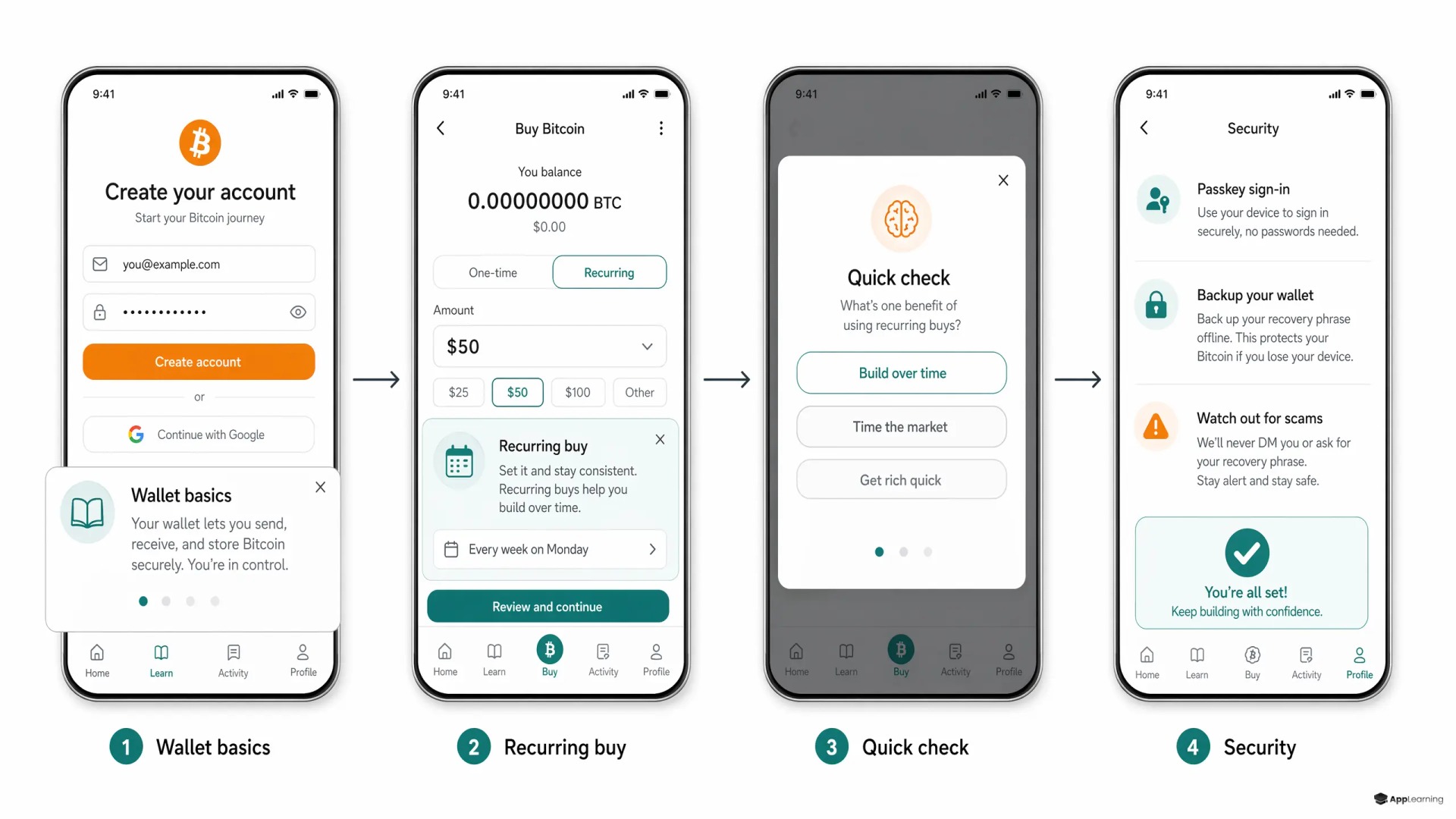
Embedded education works differently because it keeps explanation adjacent to action. App-Learning is built around short lessons, built-in quizzes, certificates, gamified mechanics, deep links and embeds, plus analytics on completions, drop-off points, popular courses, and time spent. That is the right shape for Bitcoin education because it treats learning as part of the journey rather than as a library the user must remember to visit.
- Explain one concept right before one decision.
- Break a high-risk action into a few small steps instead of one intimidating screen.
- Use short checks for understanding where mistakes are expensive.
- Keep progress visible so the user feels movement, not effort.
- Turn education into a repeatable product pattern instead of a one-off content project.
App-Learning turns education into product infrastructure
This is where the delivery model matters. App-Learning does not need to sit as a separate academy tab that competes with the core app. On its own site, App-Learning describes support for embedded learning, web and mobile delivery, role-based paths, and dashboards for completions, assessments, and readiness. For a Bitcoin product, that means the right lesson can be triggered from onboarding, from a wallet screen, or directly before a savings or self-custody step.
The Invity case shows what this looks like in practice. App-Learning shipped a fully embedded React academy in less than two months, launched 19 lessons and 6 quizzes in English and Czech, and placed contextual product CTAs inside the learning journey. The important point is not the academy itself. It is that education became part of the product system instead of sitting beside it.
Good to know
Where should a Bitcoin app start with in-app education?
Start with the flow that already creates the most hesitation or support load, usually first purchase, recurring buy setup, or withdrawal to self-custody. Keep the first version narrow and tie it to one or two product metrics.
What should be taught inside the app instead of in a help center?
Teach the concepts that block action. That usually means custody, recurring buy behavior, transfer safety, recovery phrase responsibility, and the exact product steps a user must complete next.
How do you know the education is working?
Look for lifts in activation, first transaction rate, advanced feature adoption, quiz performance, and a drop in repetitive beginner support contacts. If behavior does not change, the learning layer is not yet close enough to the decision.
Does embedded education replace disclosures and risk warnings?
No. Disclosures still matter, but embedded education makes them understandable at the moment a retail user is deciding what to do.
Measure learning like a product capability
If you treat in-app education as content marketing, you will stop at views and completions. If you treat it as product infrastructure, you connect learning exposure to product behavior. App-Learning’s admin layer already tracks completions, drop-off points, time spent, assessments, and exportable reports, which makes it possible to join learning data to activation and support outcomes.
- KYC completion to funded account
- Time from account approval to first Bitcoin purchase
- Recurring buy setup rate after educational exposure
- Wallet withdrawal or self-custody initiation and completion
- Quiz pass rates by concept and market
- Support volume tagged to beginner questions
The useful operating model is simple. Every lesson should map to a behavior, every behavior should map to an event, and every event should be segmentable by market, language, and user maturity. That is how education stops being a side project and starts behaving like a growth, trust, and support system.
See how App-Learning can turn your highest-friction Bitcoin flow into a guided in-app learning journey.
DemoStart with one journey and scale across markets
Do not begin by trying to teach all of Bitcoin. Start with the one journey where hesitation is already visible in conversion or support data. For most products, that is first buy, recurring buy setup, or first withdrawal to self-custody. Build a modular sequence of short explanations, one or two checks for understanding, and one clear next action. Then localize it, instrument it, and reuse the pattern on the next journey.
- Choose a flow with visible drop-off or repetitive support demand.
- Break the confusion into five to seven concepts users actually need to act.
- Place each explanation on the screen where the decision happens.
- Add a short quiz or confirmation step where mistakes carry high cost.
- Track behavior change, not just content completion.
- Reuse the module structure when you launch in new languages or markets.
Bitcoin apps do not win mainstream adoption by asking users to become experts before they can act. They win when the product teaches just enough, exactly when the user needs it, and turns each unfamiliar or high-stakes step into a confidence-building micro-journey. Teams that embed education into onboarding, savings, wallet use, and self-custody will not just reduce confusion. They will build trust into the product itself.