

Key takeaways
- Beginner users need clarity, pacing, and context before feature depth.
- Education quality shapes whether curiosity becomes confident Bitcoin usage.
- Structured learning improves activation by reducing hesitation at key product moments.
- A crypto education platform works best when it is embedded, modular, and measurable.
Access solved distribution, not understanding
Crypto products have become easier to find, easier to download, and easier to fund. That does not mean they have become easy to understand. A beginner can create an account in minutes and still be unsure what Bitcoin is for, why the price moves, what custody means, how a wallet differs from an exchange account, or what happens after the first purchase.
This is the real gap for Bitcoin companies. The product may be available, but the user’s mental model is not ready. The FCA’s 2025 cryptoasset consumer research found that public awareness of cryptoassets in the UK remained high at 91%, while centralised exchanges remained the dominant way users bought or obtained cryptoassets. Awareness is no longer the scarce resource. Confidence is.
Beginner investors do not need more exposure to features at the start. They need a guided path that explains the category, the risk, the mechanics, and the next action in the right order. Without that structure, the first session becomes a test of tolerance for ambiguity. Many mainstream users will fail that test quietly. They do not complain. They pause, postpone, or leave.
The first session carries too much cognitive load
A new Bitcoin user meets too many unfamiliar decisions at once. They must understand identity checks, fiat funding, price volatility, fees, custody, wallet security, tax language, fraud warnings, and the emotional weight of sending money into an asset class that still feels abstract. FINRA’s investor guidance on crypto assets and private keys makes clear that storing and securing crypto assets often comes down to storing and securing the private keys that control them. That is not a small detail for a beginner. It is a new responsibility model.
Most onboarding flows treat these decisions as interface steps. A user sees a button, a warning, a balance, and a confirmation screen. But the product has not always created the knowledge needed to interpret those elements. This creates common gaps between product access and user understanding.
- Terms appear before concepts, so users memorize labels without understanding decisions.
- Risk warnings are shown as compliance blocks, not as practical decision support.
- Wallet and custody choices are introduced before users understand responsibility and recovery.
- First purchase flows explain mechanics but often not intent, timing, or emotional risk.
- Advanced features such as savings plans, recurring buys, transfers, or self-custody depend on knowledge the product has not yet built.
The result is friction that analytics often misread. A drop-off after KYC may look like impatience. A failed first purchase may look like payment friction. Low wallet adoption may look like weak feature demand. In many cases, the deeper issue is uncertainty. The user is not stuck because the next click is hidden. They are stuck because the meaning of the next click is unclear.
Confidence is a growth variable
Education is often placed under brand, content, or compliance. That is too narrow. For a Bitcoin product, education is part of activation quality. It shapes whether users complete onboarding, fund the account, make a first purchase, return after volatility, and adopt features that require stronger conviction.
The knowledge gap is measurable. A FINRA Foundation study of new investors found that 2022 new cryptocurrency investors scored low on objective crypto knowledge, while many did not recognise the depth of their own knowledge limits in the New Investors 2022 report. That matters because overconfidence and confusion can both produce weak outcomes. One user rushes into a decision they cannot explain. Another never acts at all.
A structured learning journey changes the quality of activation. It does not push users to buy. It helps them know what they are doing if they choose to act. That distinction is important. Better education should reduce blind conversion, improve informed conversion, and make early behaviour more stable. A user who understands volatility is less likely to panic at the first drawdown. A user who understands custody is less likely to misuse a wallet. A user who understands recurring buys is more likely to evaluate them as a habit, not as a promotion.
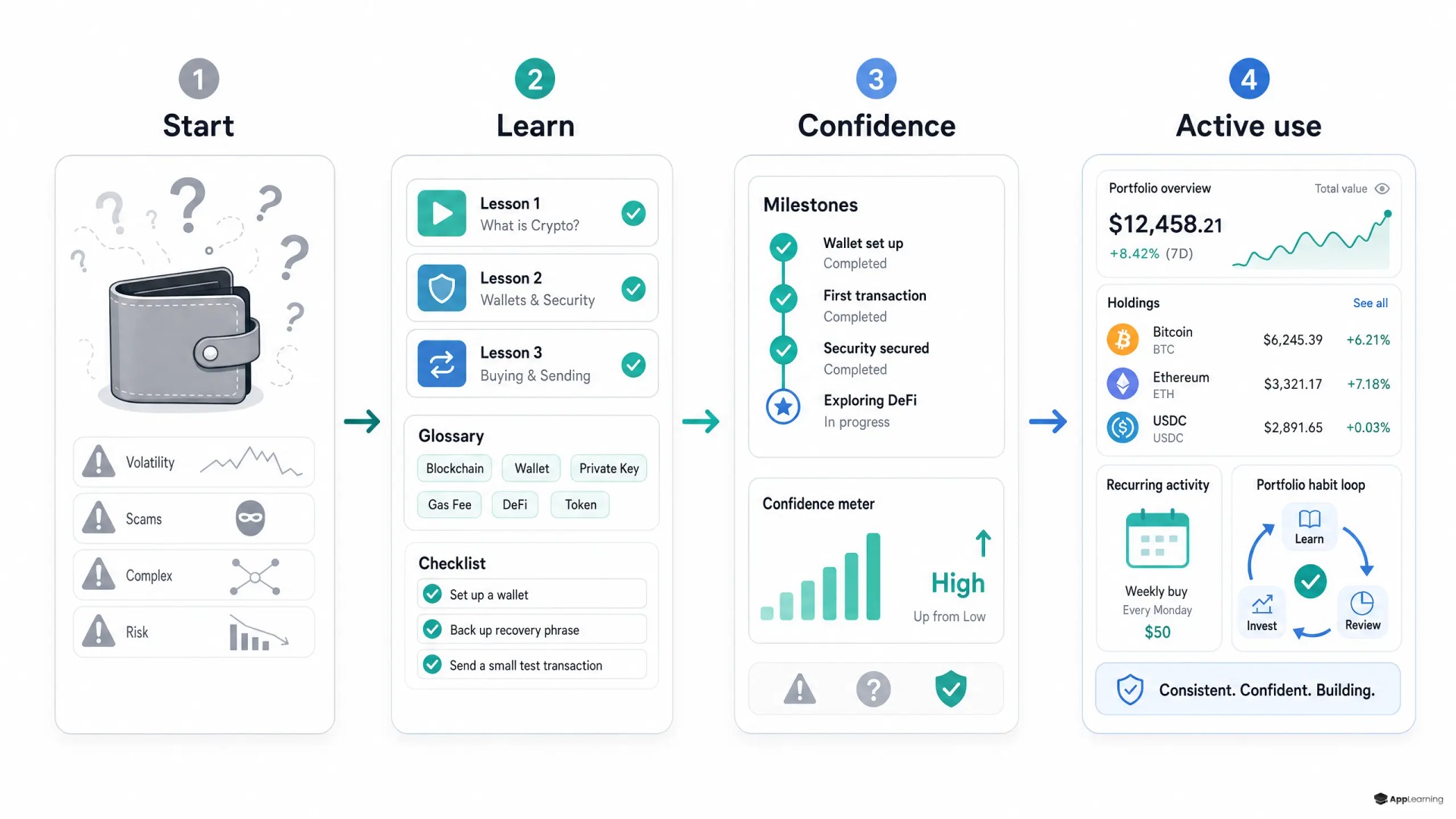
Better education is paced, contextual, and testable
Beginner crypto education fails when it tries to be exhaustive. A 40-page academy, a glossary, or a long help article may be accurate and still unusable at the moment of need. The user needs a sequence. First principles first. Product decisions second. Advanced behaviours later.
The OECD’s digital financial literacy framework for crypto-asset use points to knowledge, skills, confidence, motivation, and behaviour as part of informed use. Product teams should translate that into learning design, not only content coverage. A lesson is not successful because it was read. It is successful when the user can make a better decision afterward.
- Start with the user’s question, not the protocol’s architecture.
- Separate essential knowledge from expert knowledge.
- Teach one decision per lesson whenever possible.
- Use short checks to test understanding before high-friction actions.
- Explain risk in plain language without fear, hype, or moral pressure.
- Localise examples, units, tax caveats, and market language for each region.
- Track knowledge gaps the same way product teams track funnel gaps.
This is where learning design becomes product design. A beginner lesson before first purchase should not try to teach the full history of Bitcoin. It should explain what the user is buying, why the price can move sharply, what amount selection means, what fees are visible, and what the user should be able to tolerate. A self-custody lesson should not start with ideology. It should start with responsibility, backups, loss scenarios, and recovery limits.
Good to know
How is beginner crypto education different from a help center?
A help center answers questions after the user knows what to ask. Beginner education builds the mental model before the user reaches a high-friction decision. It should teach concepts, risks, and product actions in sequence.
Should crypto education happen before or during onboarding?
Both. The first layer should reduce fear before onboarding starts. The strongest layer should appear inside onboarding and product flows, where users face decisions about funding, first purchase, custody, transfers, and recurring buys.
Can education improve conversion without pushing users into risky decisions?
Yes. The goal is not to maximise uninformed action. The goal is to increase informed action. Clear education can help users decide whether Bitcoin fits their situation, risk tolerance, and intent.
What should a Bitcoin company teach first?
Start with the user’s first decisions. Explain what Bitcoin is, why volatility exists, what amount selection means, how custody works, what the platform can protect, and what the user remains responsible for.
A crypto education platform belongs in the journey
Education works best when it appears at the point of friction. If a user hesitates before funding, teach funding basics. If they open a wallet screen twice and do nothing, explain custody. If they cancel a recurring buy setup, explain the behaviour, not only the feature. A separate blog can support discovery, but it cannot carry the full onboarding job.
This is the operational reason to embed a crypto education platform inside the product. In the Invity Academy case, App-Learning helped move Bitcoin education from static content into an in-app learning experience with short lessons, quizzes, certificates, bilingual content, and contextual product calls-to-action. The important point is not the format alone. It is the connection between learning moments and product moments.
For product teams, embedded education also creates better signals. You can see which lessons users complete, where they drop off, which quiz questions expose misunderstanding, and how learning behaviour relates to activation. That turns education from a content cost into an operating system for confidence. Support teams see fewer repeated beginner questions. Product teams see where concepts fail. Compliance teams get a clearer path for consistent explanations.
Trust improves when education respects the decision
Trust in Bitcoin products is not built by making everything look simple. It is built by making hard things understandable. Beginner users know there is risk. Many also know they do not fully understand the risk. If the product hides complexity until the confirmation screen, trust weakens.
FINRA’s guidance on storing crypto assets explains that wallets do not hold the assets themselves and that loss of access to keys can mean permanent loss of crypto assets. For a beginner, that kind of concept cannot be buried in a support article. It needs to be taught before the user is asked to make a custody decision.
Good education is not promotional. It names what the product can do and what it cannot do. It explains volatility before a buy. It explains irreversibility before a transfer. It explains recovery limits before self-custody. It explains the difference between account security, platform custody, and personal key management. This protects the user and the brand at the same time.
Build a learning journey your users can trust.
TalkThe learning system must scale with the roadmap
Beginner education is not a one-time academy project. Bitcoin products change. Regulation changes. New markets require new language. New features introduce new responsibilities. If every learning update depends on engineers, designers, legal, product marketing, and subject-matter experts starting from scratch, the education layer will fall behind the roadmap.
App-Learning is built around that operating problem. The platform supports short lessons, learning paths, quizzes, certificates, progress analytics, and fast course production, with content that can be shaped for employees, customers, partners, or product users. For crypto teams, the same system can turn internal expertise into modular journeys that explain Bitcoin step by step without forcing the core product team to become a full-time education studio.
The strongest Bitcoin products will not be the ones that expose beginners to every feature fastest. They will be the ones that help users build understanding at the speed required for good decisions. Access gets people into the product. Structured education gives them enough confidence to stay, act carefully, and grow into long-term users.