

Key takeaways
- Internal academies can become reusable delivery IP and commercial products.
- Joint go-to-market needs standardized pathways, credentials, and proof of applied capability.
- A white-label academy separates reusable operations from client-specific expertise.
- Completion is not enough; proficiency and deployment evidence support renewal conversations.
- Start with one repeatable customer use case before expanding the offer.
The academy crosses the commercial boundary
The boundary between workforce learning and client delivery is becoming less useful. The August 13, 2026 expansion between Hexaware and upGrad Enterprise explicitly moves their relationship from internal skilling toward client engagement and joint go-to-market. That does not prove every AI upskilling partnership will follow the same path. It does show a clear commercial pattern: capability building is becoming part of the offer sold to customers.
Clients need architecture, engineering, and business teams aligned to a common delivery agenda.
For a growing technology or services company, this changes the investment case for an enterprise AI academy. Internal training is no longer only an operating cost. If it produces role definitions, practical exercises, assessment logic, facilitator guides, and governance patterns that clients also need, it creates delivery IP. The goal is not to resell employee onboarding. It is to turn a proven way of working into a reliable customer program.
Internal capability becomes delivery IP
The strongest customer-facing programs begin with a hard internal test. Teams must use the same tools, solve similar delivery problems, and work under the same security and quality constraints that customers face. Anthropic describes this sequence in its DXC alliance: DXC used Claude in its own operations before taking trained, certified engineers into client environments. That progression turns abstract AI training into a credible implementation model.
Reusable IP emerges when the academy captures the parts that should not be rebuilt for every account:
- Role-based paths for leaders, consultants, engineers, sales teams, and customer operators
- Use-case templates that connect AI concepts to real workflows and delivery decisions
- Practical assignments, review criteria, and certification thresholds
- Facilitator playbooks that let subject-matter experts teach without running program operations
- A governed content core that can be updated once and reused across cohorts
Client context still matters. A bank needs different cases, controls, and evidence from a manufacturer. The answer is not a fully custom academy each time. It is a stable core with configurable industry examples, branded portals, cohort schedules, and client-specific application work.
One operating model across many clients
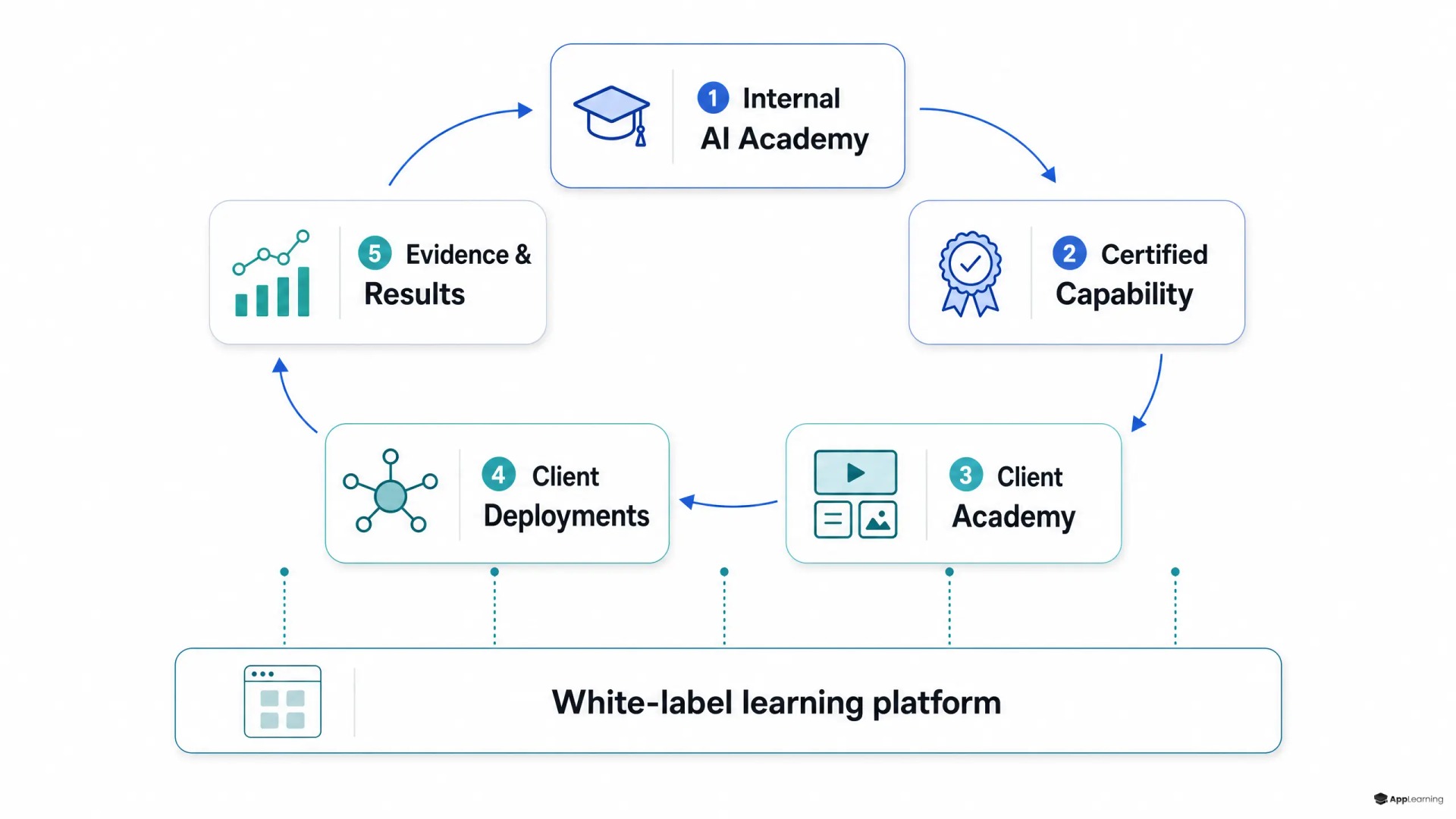
Joint selling fails when every client program depends on a spreadsheet, a fresh slide deck, and the availability of one internal expert. A partner enablement academy needs an operating architecture that separates shared infrastructure from specialist delivery. That separation lets commercial teams package the offer while SMEs focus on the work that requires judgment.
- A shared content library with version control and clear ownership
- Client spaces with separate branding, audiences, permissions, and reporting
- Cohort operations for enrolment, reminders, live sessions, and support
- Assessment workflows that combine knowledge checks with applied submissions
- Dashboards that show progress from enrolment to verified capability and deployment
This is where a white-label academy matters. It gives partners one delivery system that can appear under different client or alliance brands without creating a new platform and operating process for each engagement. For a startup with limited operational capacity, one repeatable system is far more useful than a collection of impressive but isolated workshops.
Standardization is the commercial product
Standardization does not mean generic content. It means that the buyer knows what is included, delivery teams know how to run it, and learners receive credentials with defined meaning. The AI training go-to-market offer should specify learning paths, expected time, live-touch points, assessment rules, completion requirements, and the evidence each participant produces.
The commercial unit can then be simple: an AI readiness diagnostic, a role-based foundation cohort, an applied build sprint, and a certification or capability review. Each unit has a scope, owner, price logic, and success measure. This makes the program easier to co-sell because it sits beside consulting, implementation, and managed services rather than outside them.
Good to know
When is an internal academy ready for customers?
It is ready when the internal program has defined roles, repeatable content, credible assessments, and proof that participants can apply the capability in real delivery work.
What should a customer-facing AI certification prove?
It should prove more than attendance. Define the practical task, review standard, assessor, expiry or renewal logic, and evidence required to earn the credential.
Can a small startup run this model?
Yes, if it begins with one repeatable use case. Standardize the operating layer early and reserve scarce subject-matter expertise for live application and customer context.
Evidence makes the alliance renewable
Completion rates are useful for program management but weak as a commercial outcome. Buyers need to see whether people can make better decisions, build safer workflows, or deliver customer work differently. Measure four levels: participation, demonstrated proficiency, work artefacts, and deployment evidence. For technical paths, that may include reviewed prototypes, evaluated prompts, architecture decisions, or production controls. For business paths, it may include redesigned workflows, approved use cases, and adoption data.
This evidence closes the loop between learning and delivery. It gives account teams material for renewal discussions, helps product teams identify recurring customer needs, and shows where the next learning investment should go. The academy becomes a source of market intelligence as well as a capability system.
Turn proven capability into a repeatable customer academy.
TalkThe reusable academy layer
App-Learning can provide the reusable academy layer beneath this model: a branded environment for pathways, cohorts, content, assessments, credentials, and reporting. The services partner retains its domain expertise and customer relationship. The learning operation becomes consistent, visible, and scalable across accounts.
The practical starting point is narrow. Choose one client-facing AI use case that internal teams already deliver well, build one role-specific path, define the proof required at the end, and run it with a first customer cohort. Once that operating model works, expansion becomes a product decision rather than a recurring scramble to organise training.