
Key takeaways
- The hardest migration risk is lost product behavior, not translated syntax.
- Content and publishing contracts must survive any language or framework change.
- Long-running AI work needs explicit job states, retries and recovery paths.
- Refactor proven flows before committing to a full-stack rewrite.
AI Content Pipelines Should Freeze Contracts Before Rewrites
A framework rewrite can make an AI product look cleaner while making it less safe to operate. The danger is not that a team cannot translate code from one language to another. The danger is that product rules embedded across handlers, workers, database queries and CMS calls disappear during translation. For a growing company, that can mean approved learning material publishes twice, an editor loses review context, or a failed import cannot be resumed.
That is why AI content pipeline architecture should start with behavior, not technology. A migration is safe only when the rules that protect content, reviewers and publishing targets are explicit enough to test outside the existing codebase.
A rewrite changes more than code
Early systems often grow as a chain of prompts, provider calls and CMS integrations. It works until the system becomes an AI authoring platform that creates training modules, processes source documents, generates media, routes work to reviewers and releases content to real learners. At that point, the code is carrying operational policy whether the team has named it or not.
A new framework may improve dependency boundaries, typing and developer experience. It does not automatically preserve the rule that only an approved content version may publish, that a provider timeout must not create a duplicate module, or that an editor can recover a failed job without starting again. These are product guarantees. If they are not visible in a contract, they are easy to omit in a rewrite.
The behavior hidden between prompt and publish
The visible generation step is usually the smallest part of the system. The harder behavior sits at the boundaries: parsing documents and media, normalising source material, selecting a model provider, persisting progress, validating output, collecting review decisions and publishing a specific version to a specific destination. Each boundary can fail independently.
Long-running work needs more than a loading indicator. The asynchronous request–reply pattern describes the need for a status resource, cancellation and protection against duplicate submissions. In practice, a content job needs durable states such as queued, processing, waiting for review, approved, publishing, published, failed and cancelled. The transitions between those states are the real workflow.
Retries make this distinction urgent. Google Cloud guidance on job retries and checkpoints recommends idempotent tasks so a restart does not corrupt or duplicate output. In controlled AI publishing, that means retrying generation may be acceptable, but retrying a publish action must not create two live versions or overwrite a later editorial decision.
Freeze the contracts before changing the stack
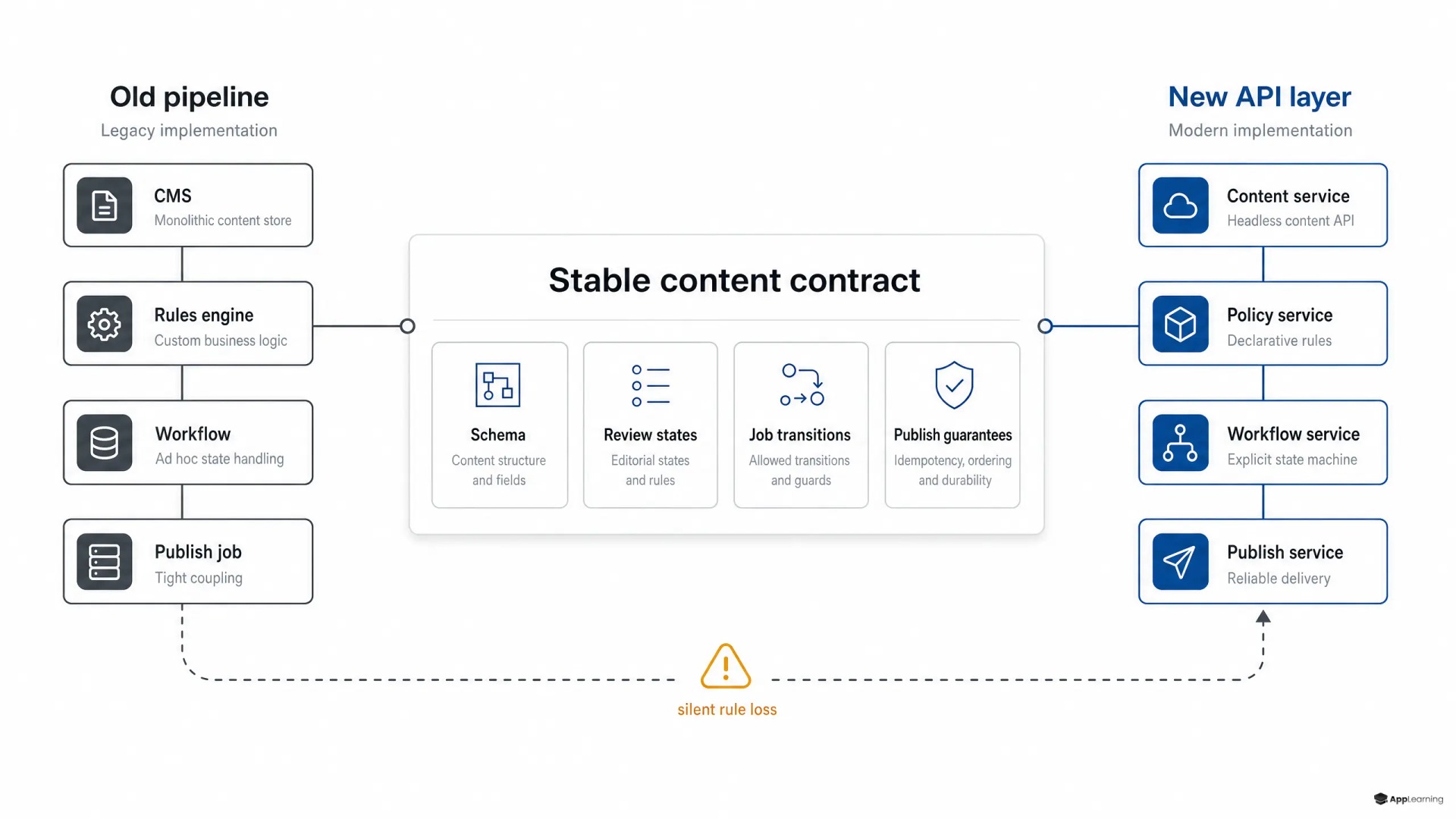
A contract-driven migration begins by recording what must remain true. This is not a slide deck. It is a set of versioned schemas, fixtures and executable tests that run against the old flow before they run against the new one.
- Content contracts define required fields, version lineage, source references, validation rules and machine-readable output.
- Review contracts define who can approve, reject, request changes or override a failed automated check.
- Job contracts define states, legal transitions, retry limits, timeout handling, cancellation and recovery ownership.
- Error contracts define what users see, what operators can inspect and which failures may be retried automatically.
- Publishing contracts define the approved version, destination mapping, idempotency key, audit record and point at which release becomes irreversible.
The purpose is not to preserve every implementation detail. It is to distinguish incidental code from the learning content infrastructure that protects real business knowledge. Once this boundary exists, a team can change providers, languages or APIs without reopening every publishing decision.
Good to know
What should be frozen before an AI content pipeline rewrite?
Freeze versioned content schemas, review permissions and states, job transitions, retry and recovery rules, error behaviour, and the guarantees that govern publishing and audit trails.
Why are job states important in AI authoring systems?
Generation, extraction and publishing can take time and fail at different points. Explicit states make work observable, recoverable and safe to retry without duplicating content or releases.
When is a full rewrite justified?
Consider it only after the current behaviour is documented and tested, and incremental refactoring or adapters cannot address the constraints. The rewrite should preserve proven contracts before it introduces new capabilities.
Refactoring creates a safer path than replacement
A full rewrite asks a team to reproduce old guarantees while also creating a new architecture. That is expensive work with little immediate user value. A safer sequence starts by characterising today’s behaviour with contract fixtures. Then split oversized entrypoints into named use cases, centralise domain rules and put adapters around external providers, storage and the CMS.
Next, introduce the new API or runtime around the proven worker and publishing flow. Run old and new paths against the same fixtures where possible. Compare outputs, state transitions and audit records. Migrate one bounded capability at a time, such as document extraction or review notifications, rather than moving generation, review and publishing together.
This sequence also gives founders a clearer investment decision. The team can measure whether each architectural change reduces operational risk or delivery time. It avoids spending scarce engineering capacity on a cleaner stack that still has to rediscover the rules that made production safe.
Map your publishing contracts before the rewrite begins.
Map contractsProduction discipline makes AI useful for learning
At App-Learning, we treat AI-supported authoring as a production system for company knowledge and learning content. Prompts matter, but they are not the system. Reliable onboarding and internal training depend on traceable source material, human review gates, recoverable jobs and controlled AI publishing that respects the organisation’s standards.
The strongest AI content systems make their guarantees visible before they make their code modern. Freeze the contracts first, then improve the architecture around them. That keeps a migration focused on safer operations and better learning outcomes rather than a costly attempt to rebuild trust from scratch.