

Key takeaways
- Evaluate microlearning across the full module, not chapter by chapter.
- A repeated chapter template can create predictable and disengaging learner journeys.
- Interactions must change the learner’s cognitive task, not just the screen layout.
- Visuals should explain relationships, while scenarios turn knowledge into workplace decisions.
Short is a format, not a learning design
A three-minute chapter can be focused, readable and technically correct. It can still be poor microlearning. Duration limits the size of a unit; it does not establish what the learner should notice, retrieve, decide or do next. A systematic review of microlearning pedagogy identifies both content design and instructional flow as central to an effective experience.
This distinction matters in finance, banking and crypto. Learners may need to understand a control, recognise a risk signal and make a sound decision under time pressure. Four short chapters that repeat explanation, a knowledge check and a completion screen may cover the policy. They do not necessarily prepare someone for the work.
Segments need an arc
Content segmentation divides a topic into manageable parts. Instructional design dramaturgy gives those parts a deliberate cognitive sequence. The learner should feel movement across the module: from orientation, to understanding, to recall, to judgment and application.
A useful learning module structure gives every chapter a distinct job:
- Set the context with a realistic business problem, risk or decision.
- Explain the principle through a concise model, process or example.
- Require active retrieval so learners must bring the core rule to mind.
- Apply the rule in a scenario that resembles a real workflow.
- Close with a practical takeaway and a link to the next decision.
Not every chapter needs every step in full. The module does. This is the core design test: does each unit advance the learner’s capability, or merely restate the topic in another small container?
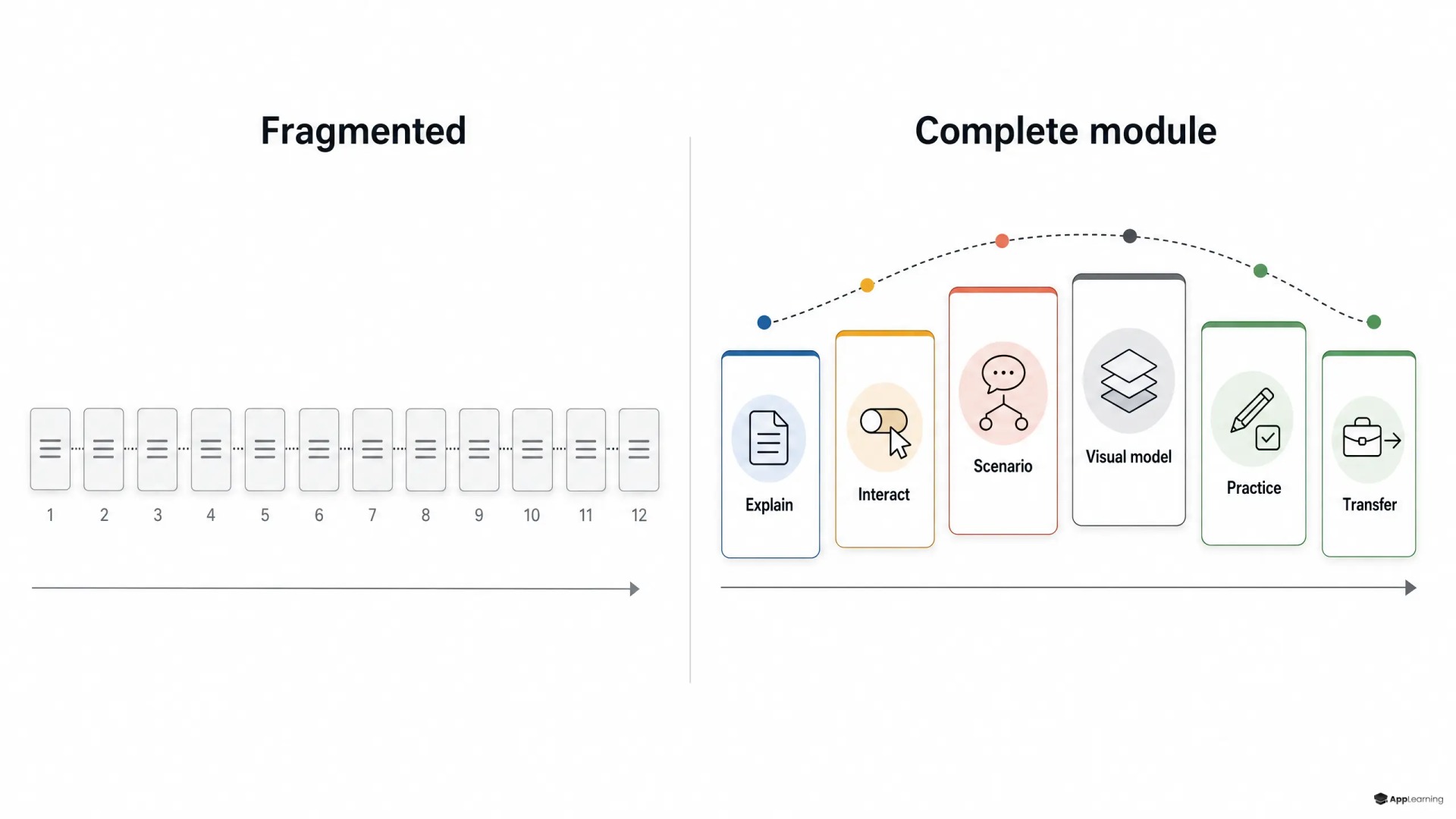
Full-module review exposes pattern fatigue
A recent evaluation of an AI-assisted authoring workflow produced a coherent four-chapter module. Each chapter contained three short sections and one quiz. The material was structured, complete and editable. Viewed one chapter at a time, it was acceptable.
Viewed as one learner journey, the weakness was clear. The same rhythm repeated too often. The language became schematic. Interactions checked recognition without creating enough judgment. Practice and transfer were thin. Several visuals illustrated the topic but did not explain the relationships that made the topic work.
That is not a failure of generation alone. It is a failure of the review lens. Teams that approve AI course authoring one chapter at a time can miss monotony, missing progression and weak transfer until learners experience the complete module. Module-level review must therefore be a formal quality gate, alongside factual, legal and brand review.
Good to know
What is instructional design dramaturgy?
It is the deliberate progression of learner activity across a module. It moves learners from context and explanation to retrieval, judgment, application and transfer rather than repeating the same chapter pattern.
How can teams assess microlearning quality at module level?
Review the full learner path in one sitting. Check for repeated interaction patterns, missing transitions, weak scenario practice, unclear visual explanations and whether each chapter performs a distinct learning role.
Can AI-generated microlearning meet compliance requirements?
It can speed up structured drafting and revision, but it still needs expert review for factual accuracy, regulatory interpretation, approval workflows and evidence of completion or assessment.
Change the learner’s work, not only the component
Interactive microlearning is not created by alternating cards, buttons and quizzes. Interaction matters when it changes the learner’s mental work. A meta-analysis of test-enhanced learning transfer found that retrieval practice can support transfer, especially when questions require application and inference rather than simple restatement.
- Use a labelled process visual to show how a control, trigger and escalation path connect.
- Ask learners to retrieve the key rule before showing the answer.
- Present a plausible customer, transaction or conduct scenario and require a decision.
- Ask learners to distinguish the relevant signal from an attractive but irrelevant detail.
- Use a short debrief to explain the consequence of the decision in the real workflow.
Visual design needs the same discipline. Decorative imagery can improve the surface of a screen, but it cannot carry the explanation. Research on signaling in learning media shows the value of cues that make important structures and relationships visible. In practice, this means diagrams should reveal sequence, cause, ownership or thresholds, not simply decorate a policy summary.
Build short learning that holds together as one complete experience.
DesignAI authoring needs module controls
The useful role of AI course authoring is not to generate isolated chapters faster. It is to help authors maintain a coherent design system across the module. App-Learning can support this by treating the brief as structured learning architecture: chapter purpose, prerequisite knowledge, cognitive activity, scenario type, visual purpose, assessment evidence and progression rules.
This changes the authoring workflow. Instead of prompting for another short chapter, the team can ask whether the next unit should explain a relationship, test recall, rehearse a decision or support transfer into a regulated workflow. Subject-matter experts retain control of accuracy and compliance. Learning designers retain control of the arc. AI helps produce, revise and compare the components within those constraints.
Microlearning earns its name when a short unit forms part of a complete learning journey. The standard is not whether each chapter is concise. The standard is whether the module helps people notice, understand, decide and act differently when the next real situation arrives.