

Key takeaways
- Workday’s two percentages use different baselines and cannot be treated as one measure.
- Prompt literacy remains foundational but does not establish advanced applied competence.
- Reviewed workflow artifacts provide stronger evidence of applied skills than course completion alone.
- Role-specific curricula should follow job tasks and minimum tool permissions.
- Readiness measures should include output quality, review effort and safe exception handling.
Hiring Data Is Rewriting the AI Training Syllabus
Two demand curves carry different baselines
In its October 5, 2026 release, (investor.workday.com) Workday reported that demand for basic AI skills fell 25% after a January 2026 peak. Demand for hands-on tool-building, workflow automation and AI engineering rose 51% between September 2025 and July 2026. The analysis covered job requisitions across more than 550 employers using Workday Recruiting.
These are different skill groups and comparison periods, not opposite sides of one measure. Requisitions signal employer demand, not demonstrated employee competence. Before treating the findings as a market-wide forecast, L&D buyers should request the skill definitions, denominators and controls for changes in employer and role mix.
On October 29, 2026, Axios reported RAISE US commitments above $735 million; (axios.com) funding is not evidence of training outcomes or causality.
The buying decision shifts toward work evidence
The useful inference for enterprise AI upskilling is a progression problem, not a reason to abandon literacy. An AI training curriculum should distinguish understanding a tool from building a dependable workflow. For fintech and crypto scaleups, a proposed three-tier academy makes that distinction explicit.
Tier 1 establishes safe operating judgment
In NIST’s governance guidance, (airc.nist.gov) AI risk training is tied to staff responsibilities and organisational policies. The foundation tier should cover approved tools, data boundaries, prompt construction, output verification and escalation. Scenario assessments can test whether an employee rejects an unapproved customer-file upload and detects a fabricated policy reference. Passing demonstrates judgment, not deployment authority.
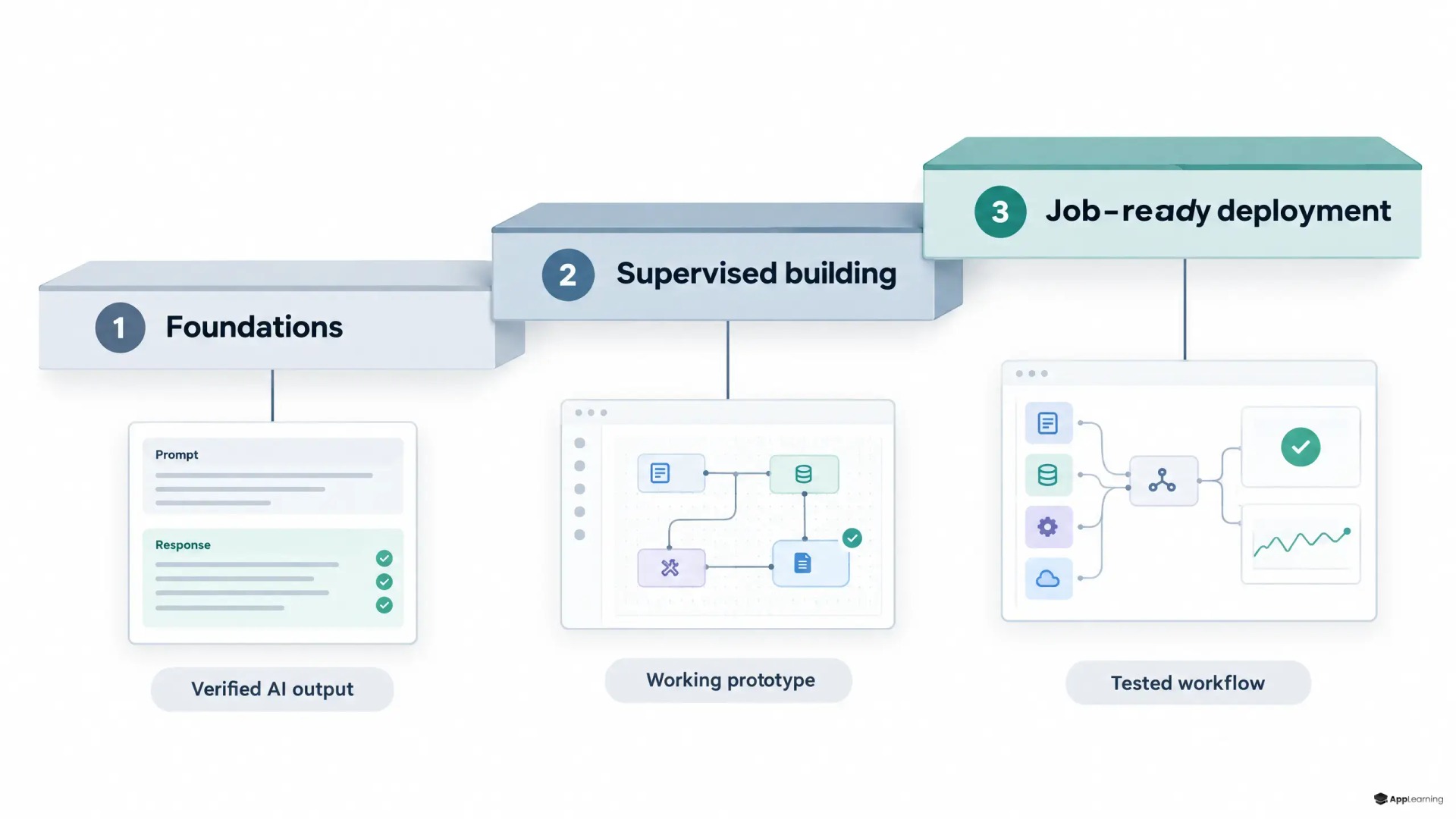
Tier 2 turns instructions into tested workflows
AI workflow automation training should centre on a bounded task. A finance operations learner might build a reconciliation-exception summary using synthetic records and approved tools. Access stays limited to the permissions the task needs. The work sample includes the workflow, test cases and debugging notes. Assessment checks missing fields, conflicting records and tool failures—not just the successful demonstration.
Tier 3 adds supervised deployment and handoff
The advanced tier should place a job-specific workflow into a controlled pilot after business-owner, security and compliance approval. The learner documents ownership, logging, monitoring, rollback and human review. Initial scope excludes autonomous payments or customer decisions. Handoff requires another operator to run the workflow and explain when to stop it.
Credentials need acceptance criteria
NIST’s measurement playbook recommends deployment-like testing and documented performance criteria; (airc.nist.gov) the academy can use that discipline without confusing system performance with learner competence.
A credible applied AI skills credential should record the task, tool version, artifact, reviewer and assessment date. Learners should meet predefined quality thresholds, handle seeded critical exceptions and explain their design choices. Unsafe data handling should block a pass. Comparable manual and assisted tasks can reveal accepted-output quality, rework and total review time—not merely faster generation.
Build an AI academy around reviewed work with App-Learning.
DiscussAcademy procurement needs an evidence trail
The buying checklist should test whether the proposed academy provides:
- Task-based pathways with defined tool permissions.
- Versioned content with named approval owners.
- Artifact submission and calibrated reviewer rubrics.
- Exportable evidence linked to role readiness.
- Reporting beyond completions and quiz scores.
In an App-Learning implementation, microlearning, scenario quizzes and tailored certificates could make progression visible. Implementation labs would supply the work samples; qualified reviewers would decide whether those samples meet the standard.
Hiring data can guide the syllabus, but it cannot certify an employee. The meaningful finish line is a bounded task performed safely, reviewed by the right person and supported by evidence someone else can inspect.