
Key takeaways
- AI generation is one capability inside a wider authoring product.
- Inputs, review states, editing actions and output formats need explicit definitions.
- Rough UX and architecture expose hidden complexity before engineering starts.
- A bounded discovery phase reduces build risk and supports a credible effort estimate.
Prototype-first work produces demo-ware
AI authoring projects often begin with the most visible capability: upload a document, call a model and generate a course. The result can look impressive within days. It can also conceal every decision that determines whether the system is usable after launch.
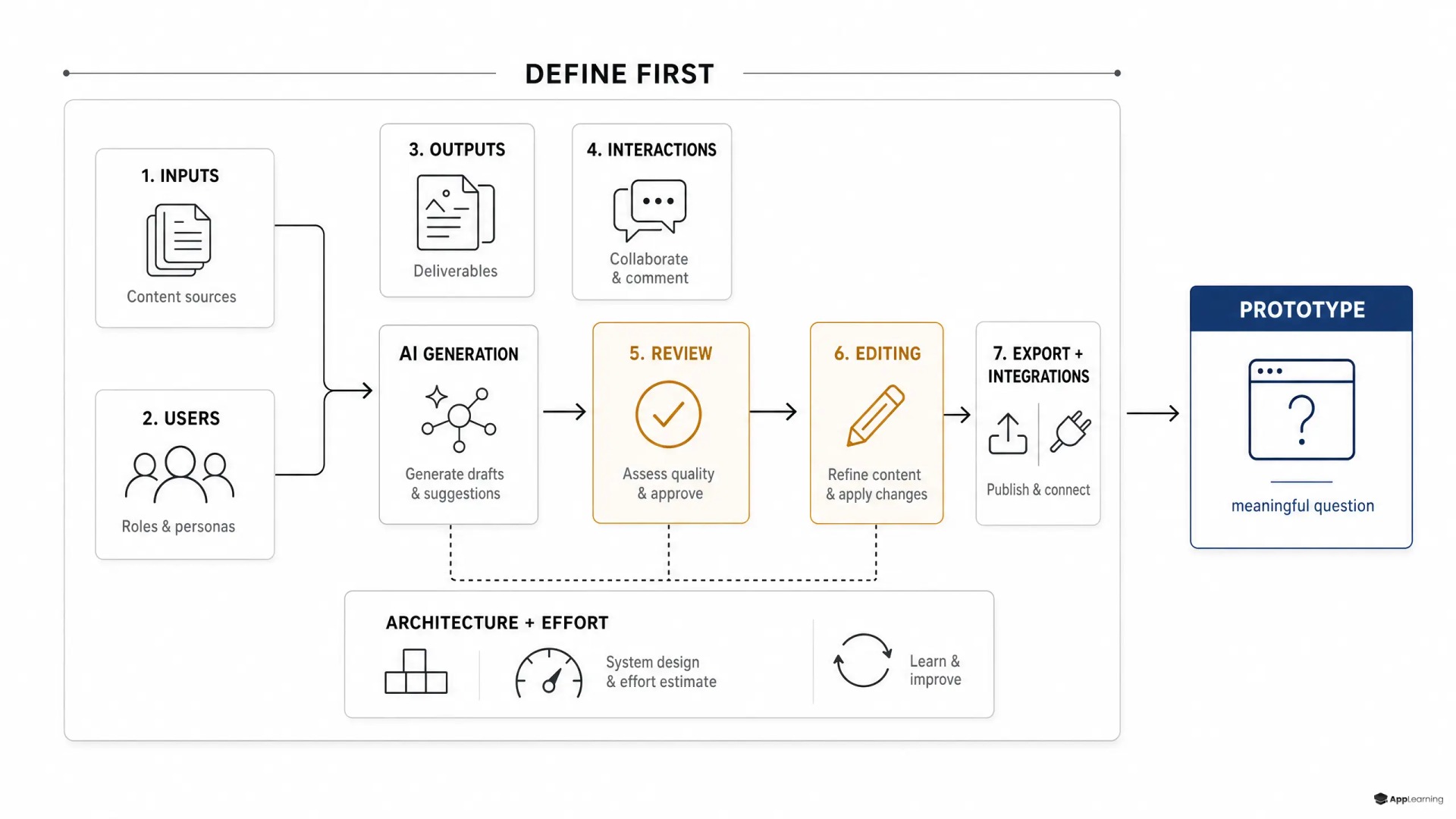
For a growing startup, this matters because internal knowledge is rarely clean or stable. Policies change, product knowledge sits with specialists, and new hires need practical guidance rather than a generic summary. An AI course creation workflow must therefore do more than turn source material into text. It must decide what counts as a reliable input, who checks generated content, how subject-matter experts edit it, and where the approved result is published.
Without those constraints, a prototype answers only whether a model can generate something. It does not answer whether the company can operate, maintain and trust the product. That is the path from a polished demo to an expensive system nobody owns.
The product definition creates the buildable boundary
The first deliverable of AI authoring product discovery should be a bounded product definition. It is not a long requirements document and it is not a technical design in isolation. It is a working decision set that defines the smallest useful product, its operating model and the trade-offs required to build it.
A credible EdTech product definition should make six areas explicit:
- Users and jobs to be done, including content owners, reviewers, editors, administrators and learners.
- Inputs, such as documents, existing training, expert interviews, structured data or company knowledge bases.
- Generated learning components, including lessons, knowledge checks, scenario exercises, summaries, cards and role-specific learning paths.
- Human controls, including source visibility, review states, approval rights, version history and escalation rules.
- Publishing and delivery, including web learning, mobile components, LMS export or direct platform delivery.
- Technical boundaries, including identity, permissions, integrations, content storage, model access and data handling.
These choices create a shared definition of success. They also stop the team from treating every possible feature as part of version one. For founders with limited budgets, that boundary is often more valuable than a fast prototype because it turns vague ambition into a decision about scope, cost and risk.
The workflow is the product
The central design task is not the generation prompt. It is the state model around generation. A learning component may move from imported source material to proposed draft, expert review, editorial revision, approval, publication and later update. Each state needs an owner, a permitted action and a clear record of what changed.
This is where rough UX work earns its place. A simple flow can reveal difficult questions early: Can a reviewer approve one quiz item while returning the rest of a module? Does editing generated text break its connection to the source? Can an administrator reuse approved components across onboarding paths? What happens when the underlying policy document changes?
The answers shape the interface, permissions model and data structure. They also determine whether experts will adopt the system. If review and revision take more work than authoring from scratch, the automation has not removed the real bottleneck.
Good to know
How long should an AI authoring discovery phase take?
It should be short and bounded, but long enough to resolve the decisions that alter scope. The goal is not complete specification. The goal is a usable product boundary, a rough architecture and an effort estimate that can support an investment decision.
Can a startup begin with a prototype instead?
Yes, if the prototype tests one narrow uncertainty, such as source extraction or question generation. It should not be mistaken for product discovery. A prototype cannot replace decisions about review, ownership, editing, publishing and integration.
Which teams should take part in the definition phase?
Include the business owner, intended administrators, subject-matter experts, a technical lead and representatives of the learner audience. A small group with clear decision rights is more useful than a large workshop without ownership.
Outputs define the integration boundary
A generated course is not a single output. One company may need mobile-first onboarding modules for new hires, while another needs reusable learning components inside an existing platform. Some teams need a direct learner experience. Others need packages or structured content that can move into their LMS. LMS product development cannot be treated as an export task added at the end, because output requirements affect component design from the beginning.
The product definition should specify which formats are required, what metadata travels with each component, how completion and assessment data are handled, and which system is the source of truth. It should also state where the product stops. A small internal-authoring tool does not need to become a full learning management system merely because it produces training.
These decisions form the learning technology architecture. They expose whether the product needs a content repository, a workflow engine, an integration layer, role-based access or a separate learner application. A rough architecture is enough at this stage, provided it makes dependencies and effort visible.
Plan the authoring product before you fund the build.
PlanDiscovery turns ambition into an engineering decision
App-Learning approaches authoring discovery as product work before implementation work. We collect requirements, define the feature set, map the core user flows, outline the learning-component model, establish the technical boundaries and convert the result into a practical effort estimate. This gives founders a basis for deciding what to build now, what to defer and what should remain outside the product.
The outcome is not a promise that AI will solve every knowledge problem. It is a testable plan for a product that can turn company expertise into maintainable learning. When inputs, review controls, editing workflows, delivery formats and architecture are defined first, implementation can target a real operating system rather than another impressive screen.