
Key takeaways
- Recruitment spend is already sunk before most churn waste appears.
- Early agent exits usually signal weak readiness systems, not just weak hiring.
- A sales academy improves confidence, consistency, and speed to productivity.
- Track time to readiness alongside early retention and sales quality.
Most field sales leaders treat churn as a recruiting problem. That misses where a large share of the waste actually shows up: after the agent is signed, after the acquisition spend is committed, and before the person becomes consistently productive.
Churn waste starts after the signup
SHRM has estimated average cost per hire at nearly $4,700, and it notes that replacement cost can range from 50 percent to 200 percent of annual salary depending on role level. For a field agent business, every early exit burns cash twice: once to acquire the agent and again to refill the territory. (shrm.org)
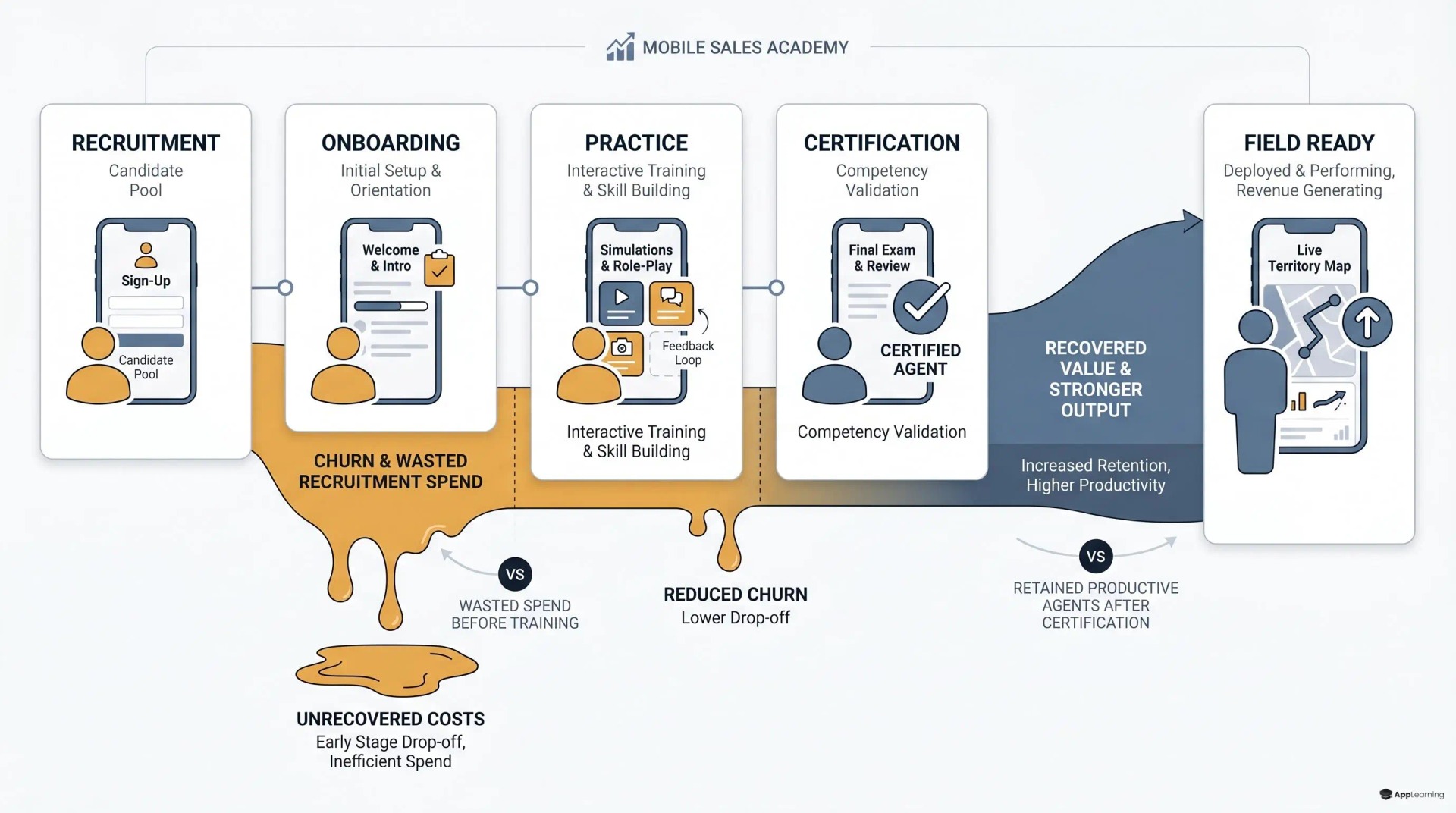
The hidden loss is post-signup leakage. Managers spend time on document checks, territory setup, device access, product briefings, shadow days, and first-shift supervision. If the agent drops before reliable execution, the business has already paid for motion that never became output.
The first 30 days decide whether the hire survives
Gallup found that only one in 10 employees strongly agree their organization does a good job onboarding new hires, and only about half strongly indicate they know what is expected of them at work. In field sales, where products change by client, offer, and region, that clarity gap quickly turns into missed conversations, weak confidence, and avoidable drop-off. (gallup.com)
- Delayed first productive shifts because basic knowledge is still fragmented
- Low confidence in front of customers during the first live interactions
- Inconsistent product claims across regions and teams
- Missed compliance or campaign steps that create rework
- Early exits that look like hiring failures but were really readiness failures
A sales academy fixes readiness before attrition shows up
ATD reported that 77 percent of organizations with a sales onboarding program cite faster productivity as a top benefit. Gallup also found that employees who feel confident in their ability to excel are 1.8 times more likely to describe onboarding as exceptional. That matters because confidence is not a soft variable in field sales. It shapes whether agents start conversations, handle objections, and come back for the next shift. (td.org)
A dedicated academy turns scattered onboarding into a repeatable operating system. It gives every agent the same product baseline, the same campaign rules, the same proof of readiness, and the same path from signup to first productive shift. That reduces avoidable variance, which is exactly what large distributed sales teams need.
The academy needs a living operating model
ATD links better sales performance to practices such as extended onboarding, rotational training, and broader sales-skill development, while Gallup finds that employees with a clear development plan are 3.5 times more likely to say their onboarding was exceptional. The lesson is straightforward: the academy has to keep teaching after day one, not stop when orientation ends. (td.org)
- Role-based onboarding that gets agents to first certified shift fast
- Product microlearning for each client brand, offer, and objection pattern
- Short practice loops for pitch delivery, compliance steps, and field scenarios
- Certification gates that prove readiness before live customer interaction
- Rapid campaign update modules so script changes reach the field in hours, not weeks
Good to know
Where should the academy sit inside the business?
Sales operations should define readiness, while enablement or HR helps build the learning flow. If ownership is vague, standards drift.
Should every agent go through the same curriculum?
No. Everyone needs the same core standard, but product modules, certifications, and updates should be role, region, and campaign specific.
Will certification slow down hiring?
It slows bad deployment, not good hiring. The point is to prevent unready agents from reaching customers.
What KPI belongs on the CEO dashboard first?
Time to first certified shift by cohort and region. It shows whether recruitment spend is turning into usable field capacity.
Measure readiness like a production metric
Training completion alone is a vanity metric. The useful question is whether recruitment spend turned into field capacity before the agent churned. That is why readiness metrics should sit next to retention metrics on the same operating dashboard.
- Time to first certified shift
- Time to first sale or first qualified interaction
- Fourteen day attendance and activity rate
- Certification pass rate by cohort and region
- Thirty, sixty, and ninety day retention
- Sales quality, compliance, and error rates after launch
See how App-Learning can turn onboarding into field readiness.
ExploreMobile delivery keeps the academy inside operations
For field organizations, the academy has to live where the work already happens. App-Learning fits that model by embedding mobile onboarding, product knowledge, certification, and campaign updates into the existing app flow, so leaders can raise agent readiness without pulling supervisors into another slow training system.
The practical takeaway is simple. If you recruit faster but still lose agents before they become confident and consistent, you are not fixing churn. You are financing waste. A dedicated sales academy protects the spend you have already made, shortens the path to revenue, and gives client brands a more reliable sales standard across the field.