

Key takeaways
- AI messaging is moving faster than proven capability outcomes.
- Regulated teams need readiness evidence, not AI feature checklists.
- Role-based practice beats broad personalization claims.
- Short feedback loops reveal gaps before audits or client harm.
- AI learning investments should connect to workflow adoption and compliance confidence.
The noise has outrun the proof
AI workplace learning has become hard to buy well because most pitches now sound the same. Vendors promise faster content, personalization, skills intelligence, copilots, tutors, and automated pathways. Some of that is useful. But in a regulated finance or crypto company, the main problem is not content speed. The main problem is proof that employees can apply the right rule, at the right moment, in the right workflow.
A weak workplace learning AI strategy creates an automated content landfill. More modules. More summaries. More dashboards. The same poor evidence. A strong strategy starts with the job: can an AML analyst spot the pattern, can a support agent explain product risk, can a manager escalate a conduct issue, can a custody operations team follow the control without improvising?
Fosway draws the useful line
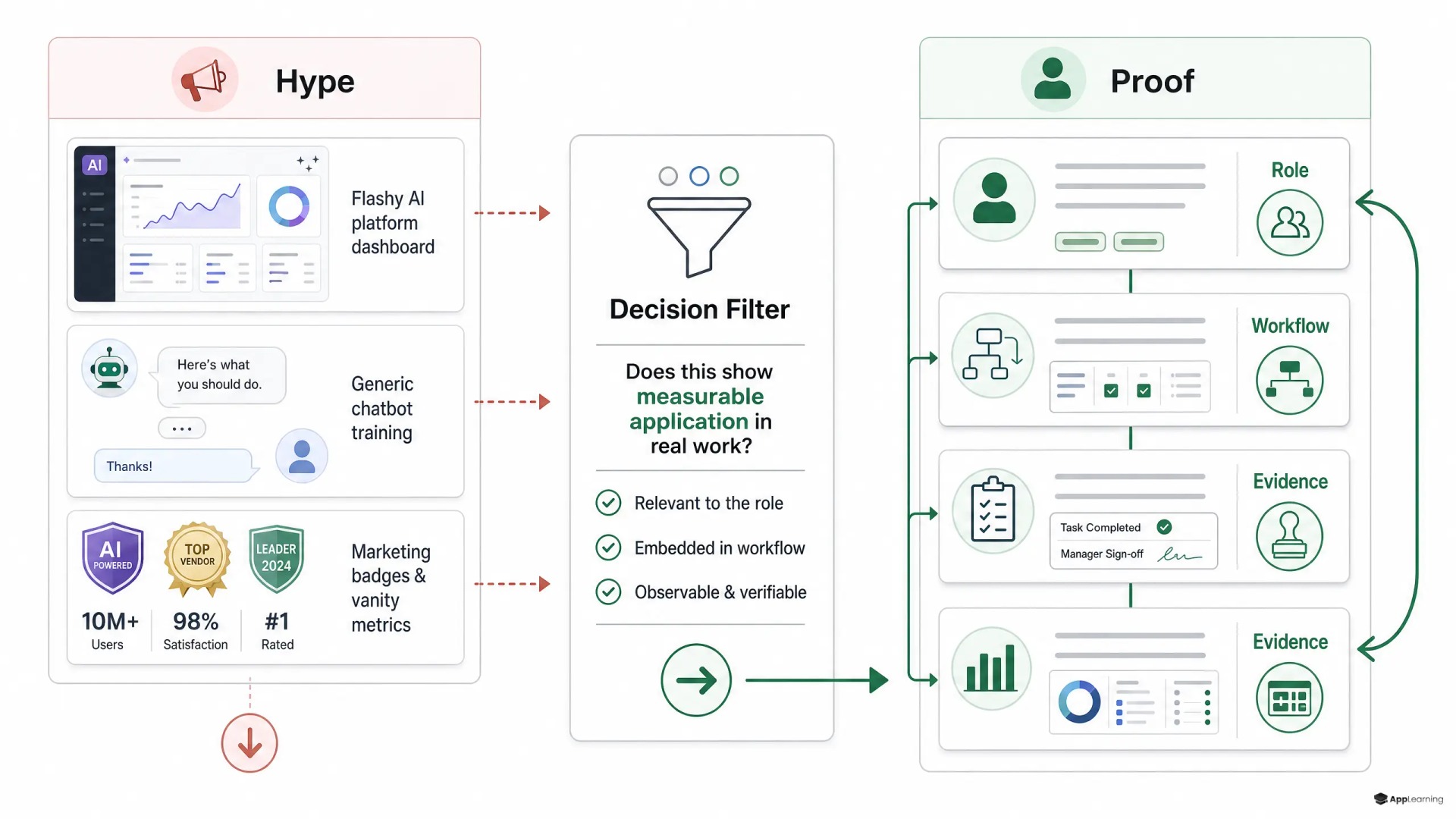
Fosway’s 2026 market view is useful because it separates real delivery from vendor theatre. Its AI assessment for digital learning says more vendors are delivering live AI features, but buyers should “demand proof over promise” and avoid paying extra for mainstream AI features. Its analysis of AI in learning systems is even more direct: vendor reality remains patchy, and there is still a gap between AI positioning, live customer use, and actual adoption.
That gives L&D leaders a practical filter for AI learning platforms. Do not ask first whether the platform has AI. Ask what is live, governed, used by customers like you, and capable of producing evidence beyond completion. Content generation, translation, localisation, search, and recommendations can help. They are not, by themselves, a capability system.
- Separate live functionality from roadmap claims.
- Ask for customer usage in comparable regulated workflows.
- Check review controls, permissions, audit trails, and opt-out options.
- Require readiness evidence beyond completion and attendance.
- Test one real role before discussing enterprise rollout.
Regulated learning starts with the role
In regulated work, competence is not abstract. The FCA defines competence as the skills, knowledge, and expertise needed to discharge the responsibilities of an employee’s role. In crypto, ESMA’s MiCA knowledge and competence guidelines set criteria for staff who provide information or advice on crypto-assets and services. The lesson is clear: training must map to role, risk, product, and decision context.
This changes AI learning vendor evaluation. A generic AI tutor can look impressive while testing the wrong thing. A useful system can build different practice loops for customer support, compliance, operations, product, and leadership. It can show which roles are ready, which scenarios still fail, and which policy updates have not translated into behavior.
Use cases that deserve budget
The strongest AI use cases in regulated learning are narrow and operational. They turn approved source material into reviewed microcourses. They generate first-draft scenarios for subject matter experts to check. They localise content without removing legal review. They assign refreshers based on quiz gaps. They give compliance, HR, and managers a shared view of readiness by role, market, and cohort.
The weak use cases are broad. “AI tutor for everyone.” “Instant skills graph.” “Personalized learning for the whole company.” These may become valuable, but only when tied to decisions and evidence. If the vendor cannot show how the AI handles policy change, role assignment, knowledge checks, failed answers, manager visibility, and audit export, the feature is not ready for regulated deployment.
Good to know
How should regulated L&D teams evaluate AI learning vendors?
Start with one role and one workflow. Require the vendor to show live functionality, expert review controls, realistic practice, readiness analytics, and audit-ready evidence.
Which AI learning features matter most in finance and crypto?
The most useful features are controlled content conversion, scenario generation, localisation with review, role-based refreshers, knowledge checks, and analytics that show gaps by team or role.
Why are completions not enough for compliance training?
A completion proves that someone reached the end of a module. It does not prove that they can apply a rule, make a correct decision, or escalate a risk in context.
Where does microlearning help regulated teams most?
Microlearning helps when policy, product, or risk updates need fast rollout and fast feedback. Short modules with quizzes and scenarios create earlier signals than long annual courses.
Short loops beat content volume
Microlearning is not just shorter video. It is an operating model: release, test, measure, adapt. A systematic review of retrieval practice found that formats such as short-answer and multiple-choice quizzes can support learning when used as active recall, not just end-of-course administration. For regulated teams, the operational value is sharper: failure data arrives before an audit, complaint, or client-facing error.
A seven-minute module with one realistic scenario, one decision point, feedback, and a follow-up check can produce a better signal than a long course with a final acknowledgement. The signal is not perfect. It does not replace supervision. But it gives L&D a live evidence loop instead of a completion spreadsheet.
A better buying test
Before buying a broad AI learning platform, run a narrow test. Pick one regulated workflow that matters. Use one policy or product update. Define the roles. Build the learning path. Measure the answers. Review the gaps with managers. Then ask whether the platform made the loop faster, clearer, and more reliable.
- Show one live workflow scenario for one regulated role.
- Show how experts approve AI-generated learning before release.
- Show analytics that separate completion, confidence, and correctness.
- Show exports or integrations for LMS, HRIS, and audit needs.
- Show how the system improves after weak answers appear.
Run a focused AI learning pilot before you buy the platform.
PilotThe pilot should prove the system
This is where App-Learning fits best. App-Learning’s platform supports branded academies, microcourses, quizzes, role-based paths, analytics, and launches in weeks once content and brand assets are ready. For finance and crypto teams, the pilot should not prove that people like an app. It should prove that a compliance change can move from source material to reviewed lesson, scored practice, and team-level visibility without months of LMS work.
The right AI workplace learning strategy is boring in the best sense. It defines the job, creates practice around the risk, measures readiness, and improves the loop. If a vendor cannot show that chain in your workflow, the AI is decoration. If it can, you have something worth scaling.