

Key takeaways
- Executive confidence can hide a large delivery gap inside teams.
- Generic AI training rarely builds role-level judgment or safe application.
- Managers need clear coaching loops to turn AI access into better work.
- Readiness should be measured through applied capability, not completions alone.
The rollout dashboard is too optimistic
AI adoption is easy to overstate. Licenses go live. Pilots launch. Completion rates rise. Leaders see movement and call it AI workforce readiness. But readiness is not access. Deloitte's 2026 State of AI in the Enterprise reported that worker access to AI rose by 50% in 2025, while organizations still felt less prepared on talent, risk, data, and infrastructure than on strategy.
That gap is sharper in finance and crypto. A support agent, compliance analyst, product owner, and relationship manager do not need the same AI behavior. Each role has different data boundaries, review duties, customer impact, and escalation triggers. If the learning system treats them as one audience, the business gets generic confidence instead of operational control.
The gap sits between strategy and work
Acorn's research makes the execution problem visible. Its 2026 Learning for AI Fluency report found that 73% of C-suite respondents agreed their organization had a clear AI strategy being executed, compared with 32% of managers and 15% of individual contributors. The same report shows a 68-point gap on manager preparedness for AI capability conversations, with 77% of C-suite leaders saying managers are very prepared and only 9% of individual contributors agreeing.
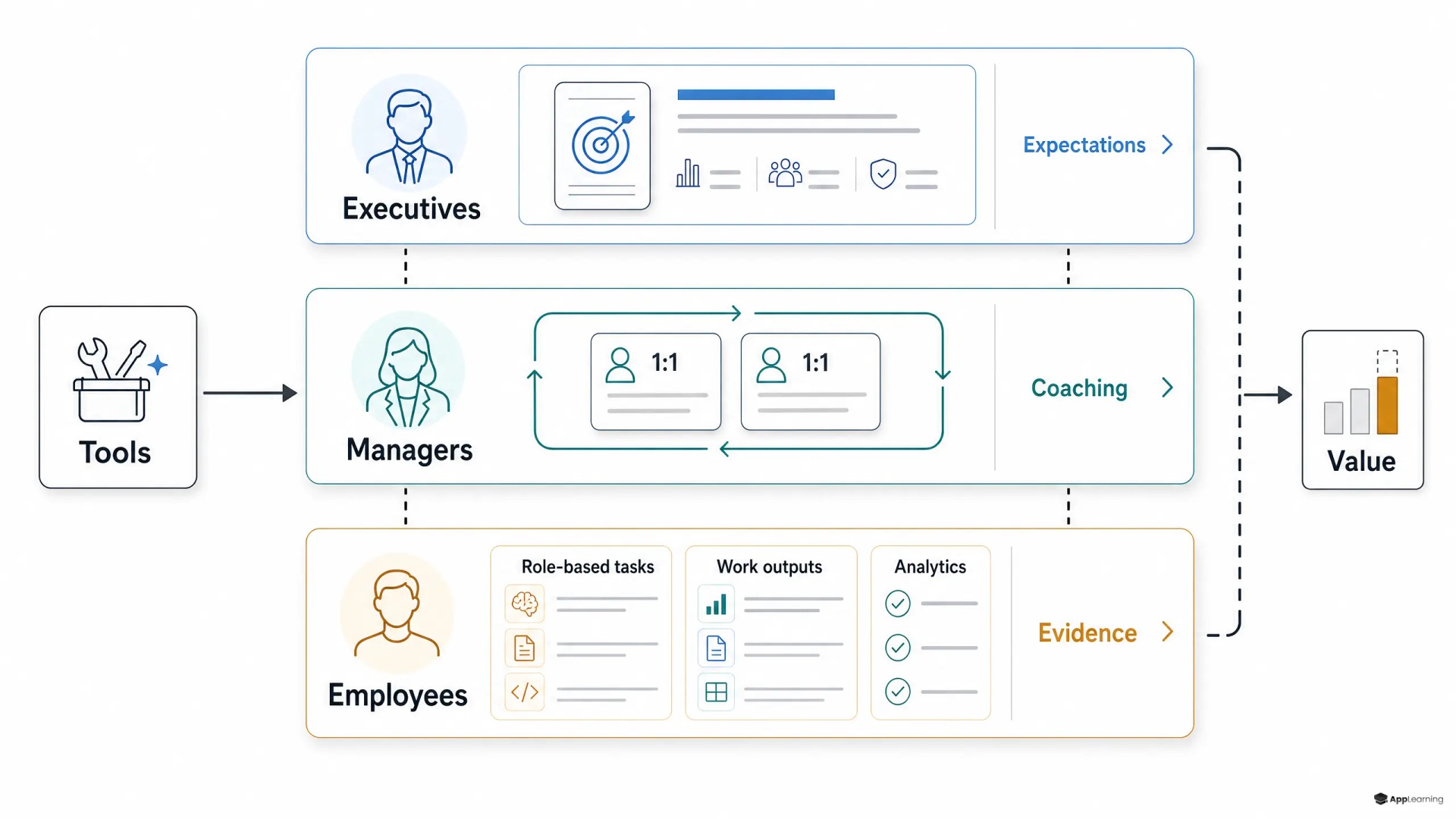
The practical reading is simple. AI strategy is being declared faster than it is being translated into work standards. Employees are asked to use AI, but not always shown what acceptable use looks like in their role. Managers are expected to reinforce the change, but often lack the playbook to inspect, coach, and correct it.
Generic awareness does not create judgment
A broad AI fluency training module can explain hallucinations, prompting, bias, and data privacy. That is useful. It is not enough. Role-based AI training has to answer harder questions. Which tasks should use AI. Which data must stay out. Which outputs require human review. Which mistakes create regulatory, customer, or market risk. Which work should never be automated.
The regulatory direction also points toward context. The European Commission's AI literacy guidance explains that AI literacy under Article 4 of the EU AI Act should consider staff knowledge, education, training, the context in which systems are used, and the people affected by those systems. That is not a call for one generic course. It is a call for proportionate capability by role and use case.
- A compliance analyst needs to test AI-supported case summaries against source evidence.
- A client-facing employee needs clear rules for disclosure, tone, and approval.
- A finance operations team needs validation steps for reconciliations and exception handling.
- A product team needs guardrails for research synthesis, backlog shaping, and customer data use.
- A manager needs coaching prompts and review criteria for each of these workflows.
Managers turn fluency into operating discipline
Managers are where AI enablement becomes real or fails quietly. They see the work after training ends. They decide whether an AI-assisted output is acceptable, whether rework is normal, and whether a shortcut has crossed a risk boundary. Without manager AI enablement, AI use becomes private improvisation.
This is also where hidden cost appears. Workday research found that nearly 40% of AI time savings are lost to rework, and only 14% of employees consistently get clear, positive outcomes from AI. Rework is not only a productivity issue. In regulated teams, it is also a control issue because errors can move through workflows before anyone knows who checked what.
Readiness needs evidence beyond completion
L&D cannot prove AI workforce readiness with attendance alone. The Learning News summary of Acorn's survey reported that 77% of organizations treat training completion as evidence of capability, while 34% have not defined AI competencies at role level and 30% have no formal mechanism to assess individual AI capability.
A better readiness model uses evidence from the work itself. It does not need to be heavy. It does need to be specific.
- A role AI task map with approved, restricted, and prohibited uses.
- Scenario assessments based on real finance, compliance, and customer workflows.
- Manager check-ins that inspect applied judgment, not tool enthusiasm.
- Evidence signals such as output quality, escalation accuracy, rework reduction, and policy adherence.
- Refresh loops when tools, regulation, risk appetite, or role expectations change.
Good to know
What is role-based AI fluency?
Role-based AI fluency is the ability to use AI safely and effectively in the specific tasks, risks, data boundaries, and decisions of a job role.
Why is generic AI training not enough for finance and crypto teams?
Generic training builds awareness, but finance and crypto roles need task-specific rules for data use, review standards, compliance escalation, and customer impact.
What should L&D measure instead of AI training completions?
L&D should measure applied capability signals such as scenario performance, manager observations, output quality, rework reduction, escalation accuracy, and policy adherence.
Where do managers fit into AI workforce readiness?
Managers translate AI expectations into daily work. They coach judgment, inspect outputs, reinforce standards, and catch risk before poor AI use becomes normal practice.
Short loops beat one-off programs
The operating model should be smaller and tighter than most AI training programs. A five-minute scenario. A realistic task. A clear standard. A manager coaching prompt. A measurable signal. Then another loop next week. This is how AI fluency training becomes behavior, not content consumption.
This is the App-Learning angle. For finance and crypto companies, modern learning has to combine engagement with control. Short, role-based journeys can move faster than legacy LMS courses while still giving HR, L&D, compliance, and managers evidence that capability is improving. The point is not to make training feel lighter. The point is to make readiness visible at the level where risk and value are created.
Build role-based AI fluency without slowing the business.
PlanThe real AI rollout starts after access
AI rollouts fail when companies confuse deployment with adoption and adoption with capability. Tools create the possibility of better work. Role standards, manager coaching, and evidence loops turn that possibility into operating practice. If leaders want AI to improve speed, quality, and control, they need to stop asking who completed training and start asking who can use AI well in the work that matters.