

Key takeaways
- Issuance, settlement, collateral eligibility and operational mobilisation are separate checks.
- DLT Pilot Regime licensing alone does not establish collateral eligibility.
- Standard criteria, dedicated requirements and eligible CSD/T2S arrangements remain essential.
- Role-based drills test evidence, decisions and escalation rather than tokenization vocabulary.
- Versioned modules separate foundational learning from operational readiness approval.
On 23 November 2026, the ECB approved conditional acceptance of marketable assets issued on platforms licensed under the EU DLT Pilot Regime as Eurosystem collateral. (ecb.europa.eu) The training challenge is not simply explaining tokens. Employees must distinguish how an instrument is issued, where it settles, whether it qualifies and whether the bank can mobilise it.
The collateral route remains hybrid
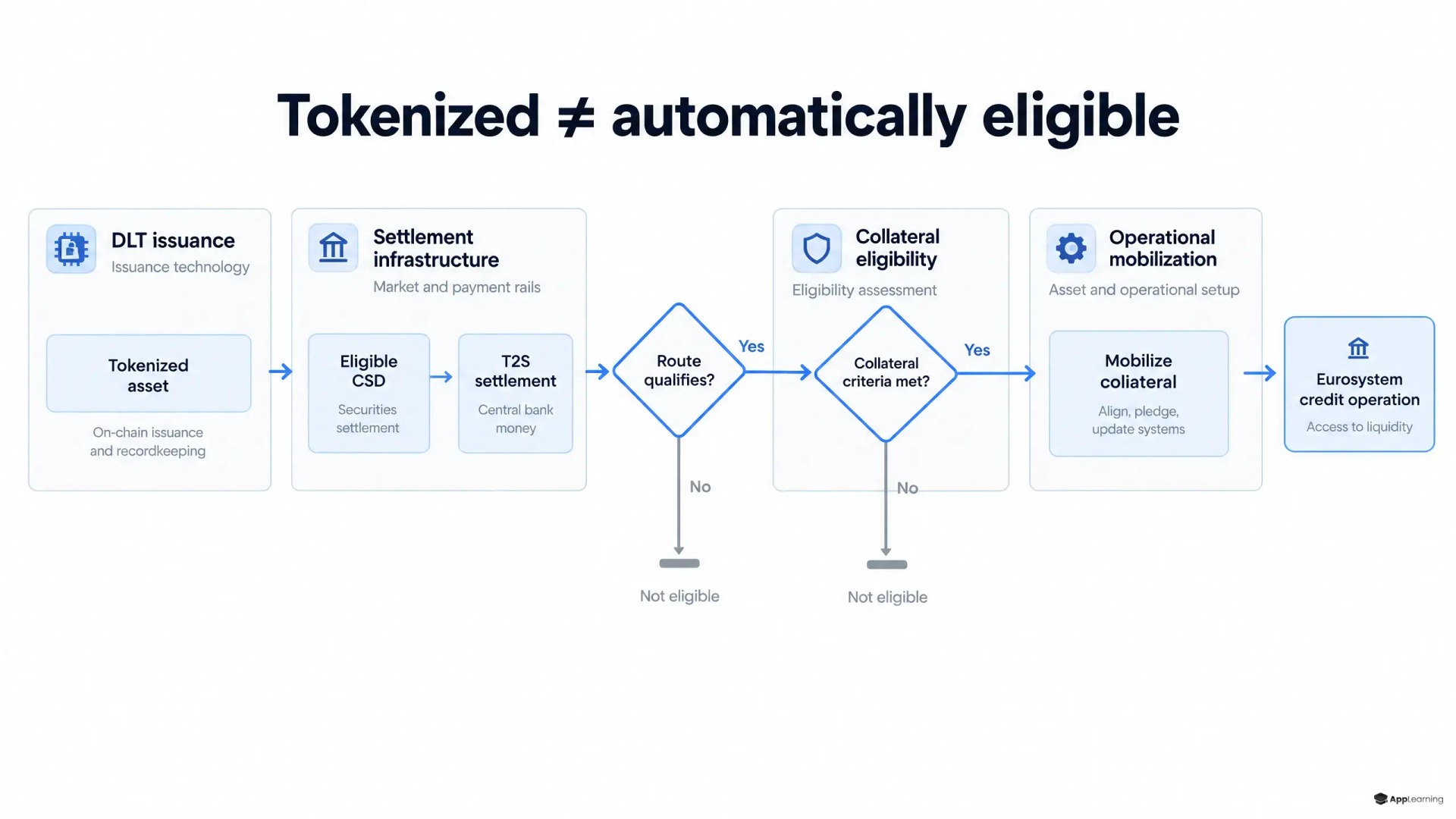
The ECB tokenized collateral decision requires an eligible link to a central securities depository operating an eligible securities settlement system that complies with CSDR and offers T2S settlement. (ecb.europa.eu) A useful learning diagram therefore separates the infrastructure route from the checks governing its use.
DLT issuance → eligible link to CSD → eligible securities settlement system offering TARGET2-Securities settlement → collateral mobilisation through approved arrangements.
Standard asset criteria, including credit quality, still apply. (ecb.europa.eu) Platform permission and an infrastructure connection should therefore be separate evidence fields in the training cases, not substitutes for an asset assessment.
Pontes, launched on 21 September 2026, enables wholesale tokenised transactions to settle in central bank money. (ecb.europa.eu) That addresses settlement; it does not by itself establish collateral eligibility. The academy should keep those decisions separate.
Three cases expose the decision boundaries
These hypothetical drills teach reasoning, not official operational guidance or approval of any instrument.
- Complete future evidence pack. Assume all published requirements are met after implementation. The learner proceeds to the bank’s approval and mobilisation checks, rather than treating eligibility as completed delivery.
- Licensed platform without an eligible link. The learner identifies the missing infrastructure condition and escalates instead of marking the asset ready.
- Connected infrastructure with missing credit evidence. The learner records eligibility as unresolved and routes the evidence gap to the designated reviewer.
A shared primer branches into role decisions
For tokenization training, banks need a common vocabulary followed by different tasks. ESMA publishes authorised DLT infrastructures and their permissions. (esma.europa.eu) That register belongs in the evidence workflow, not at the end of the eligibility decision.
- Treasury distinguishes potential collateral from verified usable collateral and explains unresolved dependencies before including assets in funding assumptions.
- Collateral operations traces the delivery route, checks required evidence and rehearses failed mobilisation and escalation.
- Risk reviews asset criteria and unresolved legal questions, with legal specialists supporting interpretation.
- IT maps interfaces and data handoffs, then tests exception handling and recovery with operations.
The release schedule becomes a learning schedule
The ECB expects detailed dedicated requirements in spring 2027, with implementation planned for June 2027. (ecb.europa.eu) Its announcement identifies settlement finality designation and outsourcing of critical functions among the areas those requirements will address.
- Now. Publish the primer and uncertainty drills, clearly separating announced conditions from unresolved specifications.
- After publication. Have policy owners validate changes, version affected modules and withdraw superseded scenarios.
- Before planned implementation. Run role-specific readiness checks against published requirements and bank-approved procedures, with named sign-off owners.
Build a role-based collateral learning pilot with App-Learning.
Plan pilotReadiness needs evidence beyond course completion
A small treasury microlearning pilot should establish a baseline, then measure false eligibility approvals, correct escalations and delayed recall. Branching drills can reward justified decisions rather than speed. In an App-Learning academy, each module should carry its source date, version and accountable reviewer; updates should trigger targeted reassessment.
DLT Pilot Regime collateral readiness is not a certificate in tokenization. It is the ability to identify missing evidence, stop an unsupported decision and hand the issue to the right owner. That is the capability worth building before implementation.