

Key takeaways
- Virtual balances should not be treated as protection against misleading competitive incentives.
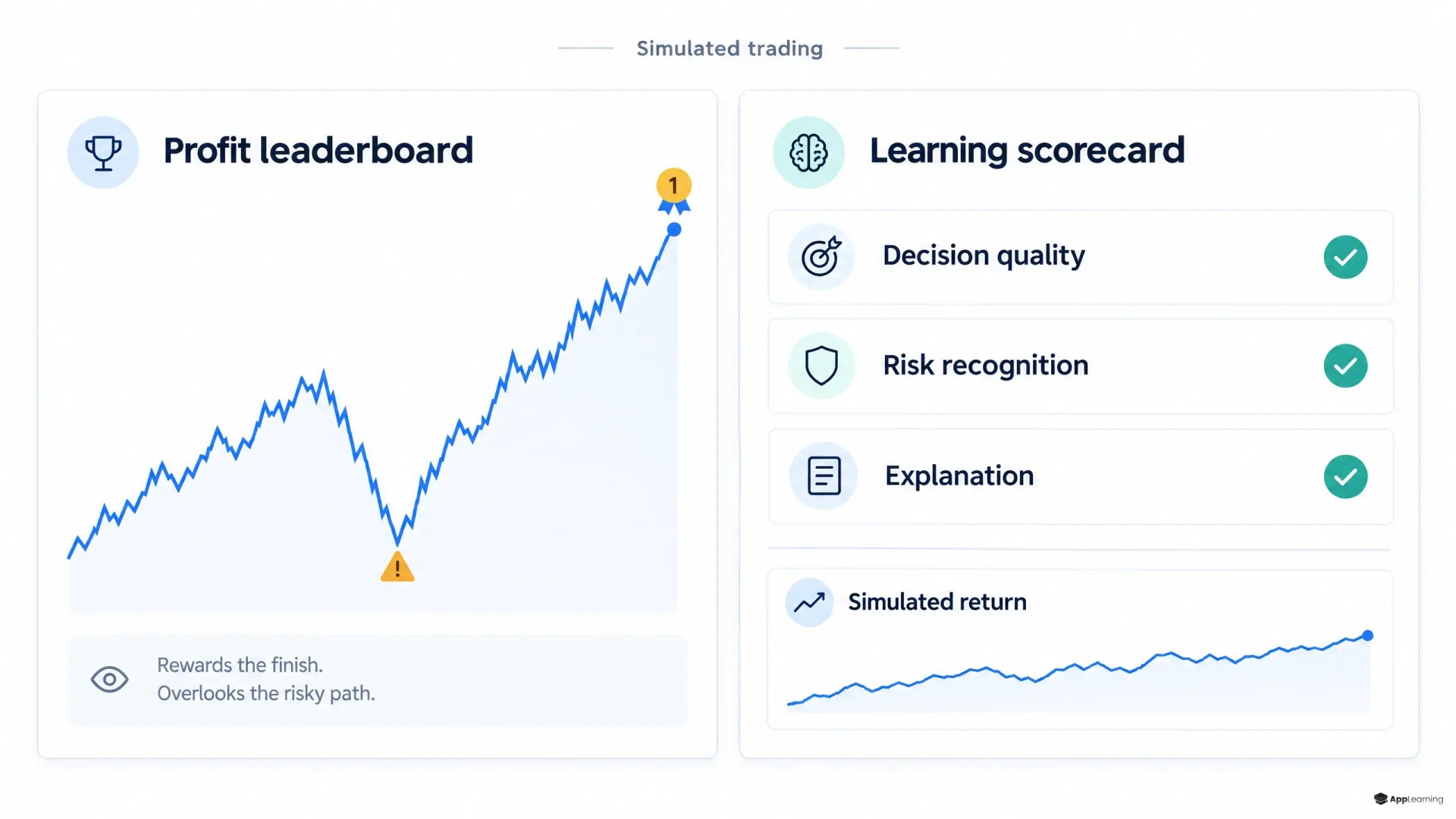
- Simulated returns belong beside knowledge and decision-quality scores, not inside them.
- Learning scenarios need uncertainty, fees, volatility and meaningful loss conditions.
- Risk comprehension and delayed recall are stronger learning targets than trading volume.
- Voluntary learning should remain separate from live-trading incentives.
The campus lab sets an ambition, not an outcome
On 20 November 2026, LBank Labs announced Next-Gen Trader Lab,(lbank.com) targeting more than 50 universities and student organisations and over 10,000 young people. The announcement promises 1,000 virtual USDT per participant and weekly leaderboards. It listed a preview for 24 November and a challenge start for 28 November 2026. These are plans and recruitment targets, not achieved participation or demonstrated learning outcomes.
The educational question is broader than this programme. Crypto trading simulation education should distinguish making virtual money from understanding the decisions that produced it.
A returns leaderboard can reward the wrong winner
An FCA trading-app experiment found that engagement features can increase trading frequency and risk-taking;(fca.org.uk) that supports scrutiny of incentives, not a verdict on this campus programme.
Consider two hypothetical participants. Maya concentrates 90% of her virtual balance in one token, finishes up 25%, but experiences a 45% peak-to-trough drawdown. Leon spreads exposure across three fictional assets, retains an unallocated balance and finishes up 5% with a 10% drawdown.
Maya wins on returns. Neither result establishes who understood risk. A second scenario could make Leon’s three assets fall together, testing whether he recognises the limits of his diversification.
Decision quality needs its own score
A proposed rubric could score three dimensions from zero to three. These are design hypotheses, not validated measures.
- Risk recognition identifies concentration, fees, volatility and possible losses.
- Reasoning explains uncertainty and trade-offs before outcomes are revealed.
- Decision consistency follows declared limits or documents a justified revision.
Simulated profit and loss, maximum drawdown and concentration would remain separate displays. Knowledge checks would have their own results. A profitable outcome would never erase weak reasoning, and a well-explained decision not to trade could earn full learning credit.
The academy connects each choice to a short lesson
European supervisors warn about sharp price movements and liquidity constraints;(esma.europa.eu) those risks belong inside the exercise, not only in a disclaimer.
For App-Learning, the useful design unit is a short mobile sequence inside an embedded academy. Gamified financial education can reward an explanation rather than another transaction.
- Complete a baseline knowledge check and a short lesson on concentration and drawdown.
- Choose a hypothetical allocation or abstain, then record the reasoning.
- Reveal fees, an adverse price path and a constrained selling scenario.
- Compare alternatives and receive feedback tied to the rubric.
No purchase or live trade is needed for this proposed sequence.
Learning evidence and audience safeguards come first
The CCSF recommendation published on 17 November 2026 supports proportionate risk-comprehension measures and a prior impact assessment;(banque-france.fr) it is not a new simulation-scoring mandate.
A pilot should randomly compare returns-led and decision-led scoring under identical scenarios. Independent assessments before, immediately after and one week later would test crypto risk literacy using new questions. Trading volume would not count as learning.
The lab’s public registration form requires an LBank UID,(docs.google.com) but does not establish its minimum age or final scoring rules. Those remain unverified as of 26 November 2026. A separate learning design should make participation voluntary and avoid deposit requirements, purchase rewards or prompts toward live trading.
Build an embedded academy that rewards risk understanding.
DiscussThe release checklist defines responsible fintech gamification
- Publish scenario assumptions and scoring criteria before participation.
- Separate assessment data from transaction and conversion metrics.
- Verify age safeguards, regional eligibility, privacy controls and final reward terms.
A simulation should count as educational progress when a learner can explain a loss, recognise uncertainty and justify doing nothing. The strongest evidence of winning is reasoning that survives a different market path, not the largest virtual balance.