

Key takeaways
- Lending income and staking remuneration come from different mechanisms with different failure modes.
- Liquidity restrictions and principal-loss scenarios belong before opt-in, not only in legal documents.
- Education, legal disclosure, regulatory assessment and consent serve distinct purposes.
- Comprehension measures should remain separate from purchase incentives and conversion targets.
- Localized modules need versioned product facts and compliance approval.
A French recommendation challenges borrowed reassurance
France’s Consultative Committee for the Financial Sector (CCSF) adopted its crypto-holder protection recommendation on 10 November 2026, published on 17 November. It warns that savings-like labels can suggest protections a crypto product does not provide.
These are nonbinding recommendations for stronger protection, not enacted EU law. The product-design implication is clear. Crypto earn product education should explain the economic mechanism before opt-in. A familiar label cannot do that work, and a clicked disclosure alone cannot establish comprehension.
Three mechanisms need three different explanations
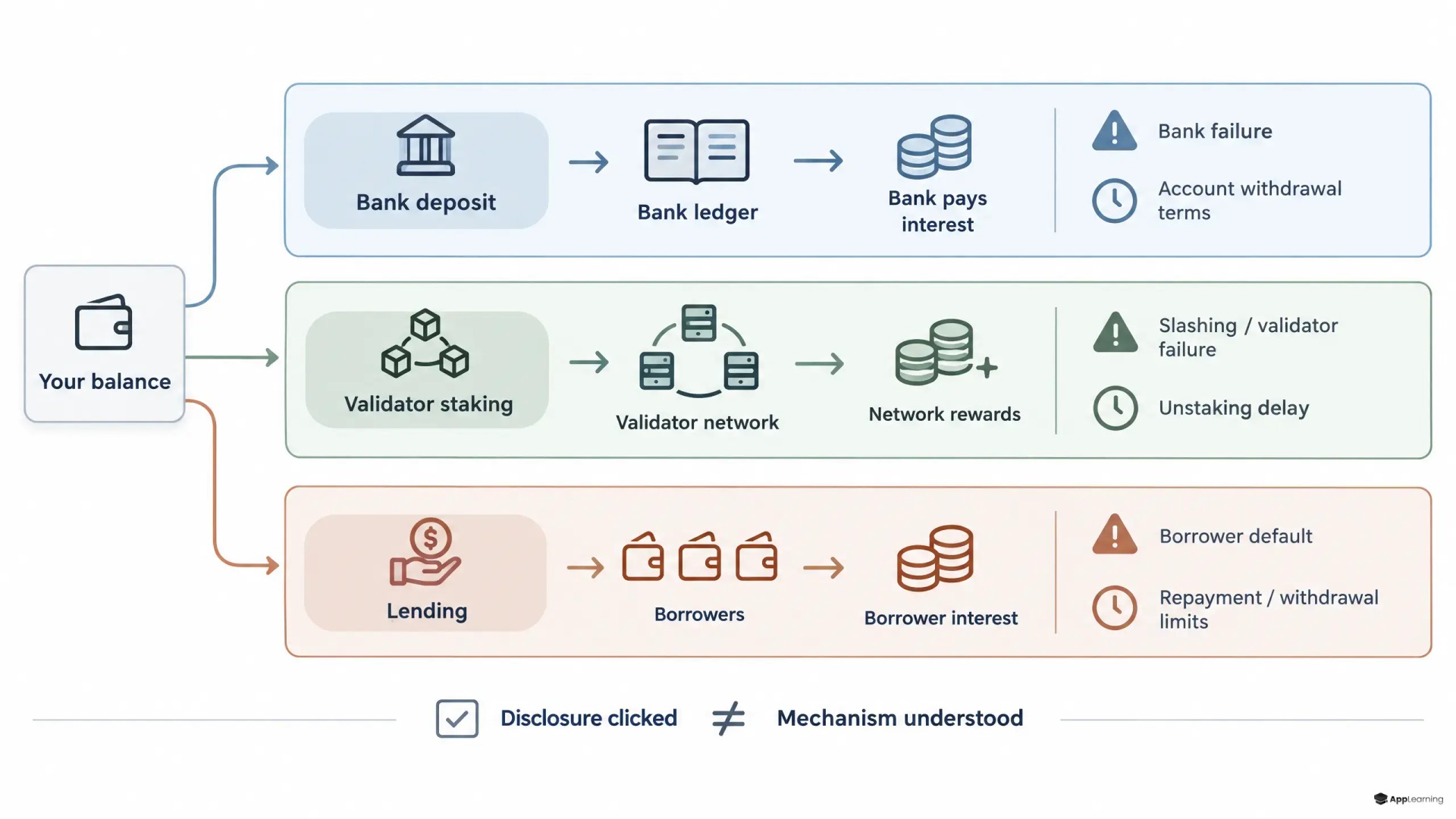
Eligible bank deposits have statutory deposit-guarantee protection within applicable limits. An earn label cannot establish equivalent protection. The EBA–ESMA description of lending and staking supports a neutral comparison using three fields—remuneration, access and failure exposure.
- Bank deposit — Bank-paid interest, if offered; access under account terms; eligible balances protected within deposit-guarantee limits.
- Staking — Remuneration from proof-of-stake participation, less applicable fees; possible unstaking delays; protocol penalties where applicable, operational failures and asset-price losses.
- Lending — Borrower interest, less applicable fees; withdrawals depend on contract and liquidity; borrower or platform failure can cause losses.
Three minutes should test consequences, not vocabulary
A proposed three-minute mobile lesson could spend one minute on remuneration, one on access and losses, and one on two scenarios. Staking risk disclosure and crypto lending education need separate branches, consistent with the CCSF’s service-specific recommendations.
- Access scenario — The customer needs assets tomorrow during a stated withdrawal restriction. Is immediate access assured? No; feedback shows the actual withdrawal or unstaking conditions.
- Loss scenario — A validator is slashed or a lending borrower defaults. Could principal be lost? Feedback explains the relevant mechanism, who bears losses and any contractual protection.
Collateral-liquidation thresholds belong in a borrowing branch where applicable, not in every lender’s lesson. Explanations should match the product, not merely the underlying asset.
Good to know
Which product facts need an owner?
Remuneration, fees, custody, withdrawal conditions and loss allocation each need a named owner and change notification.
What should compliance approve for each market?
Terminology, scenarios, feedback, translations and the separation between learning checks and legally required processes.
Learning and consent need separate records
The knowledge check should remain distinct from legal disclosure, any required suitability or appropriateness assessment, and explicit consent. Each needs its own purpose and record. A correct answer should not double as transaction authorization. Qualified legal review should confirm applicable rules, actual terms and protections for each product and jurisdiction.
Build mechanism-specific education into your product with App-Learning.
DiscussThe academy needs release discipline
Each reusable module should carry a mechanism, locale, product version, source, reviewer and approval date. Changes to fees, custody, exit terms or loss allocation should trigger review of affected explanations and translations. AI-assisted drafts should remain behind compliance approval.
Measurement should track first-attempt answers, recurring misconceptions and remediation by language and version. Completion is a separate metric. Rewards, if used, should recognize learning—not deposits or purchases. Choosing not to proceed must remain a valid outcome.
For App-Learning, this is the useful role of an embedded academy—a maintained learning layer inside the product, not another promotional library.
The standard for crypto investor protection should be an informed decision, not a faster acceptance click. Before opting in, the customer should understand who pays, when assets can return and what could prevent their return.