

Key takeaways
- CMS hosting, inference geography and processing contracts are separate approval decisions.
- An approved provider does not establish local inference or EU-only residency.
- Reviewed source lessons and locale-specific terminology anchor the localization chain.
- Quiz explanations and risk disclosures need specialist sign-off before publication.
- Native CMS translation and external authoring require different operating budgets.
A translated lesson is not an approved lesson. For a regulated academy, an enterprise AI translation CMS should be assessed as a content supply chain, not just a language tool.
Approved routing changes the CMS boundary
Strapi’s 18 November 2026 release roundup describes Strapi AI Enterprise as a paid add-on for self-hosted Enterprise projects on v5.59.0 or later, routing requests directly to the customer’s provider rather than Strapi-managed inference. (strapi.io) The architectural implication is clear. Provider selection can sit within the enterprise’s procurement boundary, while content approval remains a separate responsibility.
The add-on covers two specific jobs
The documented scope is translation and media metadata generation, including image alternative text and captions; the Content-Type Builder AI assistant is excluded. (docs.strapi.io) This is not an autonomous academy-authoring system. Glossary enforcement, assessment validation and specialist approval should remain explicit acceptance criteria, not assumed capabilities.
Self-hosting stops at the inference boundary
Strapi documents configurable provider endpoints, server-side credentials, feature-specific models and a tested-provider list. (docs.strapi.io) A proposed architecture could connect directly to an approved endpoint or use an enterprise-controlled gateway. Private inference would need its own compatibility and quality tests.
The EDPB distinguishes processor contracts from additional conditions governing transfers outside the EEA. (edpb.europa.eu) Self-hosted CMS, provider geography and contractual safeguards therefore need separate review. Before promising EU-only processing, legal and security teams should verify the DPA, subprocessors, retention, support access and transfer terms. BYO provider is not proof of data sovereignty.
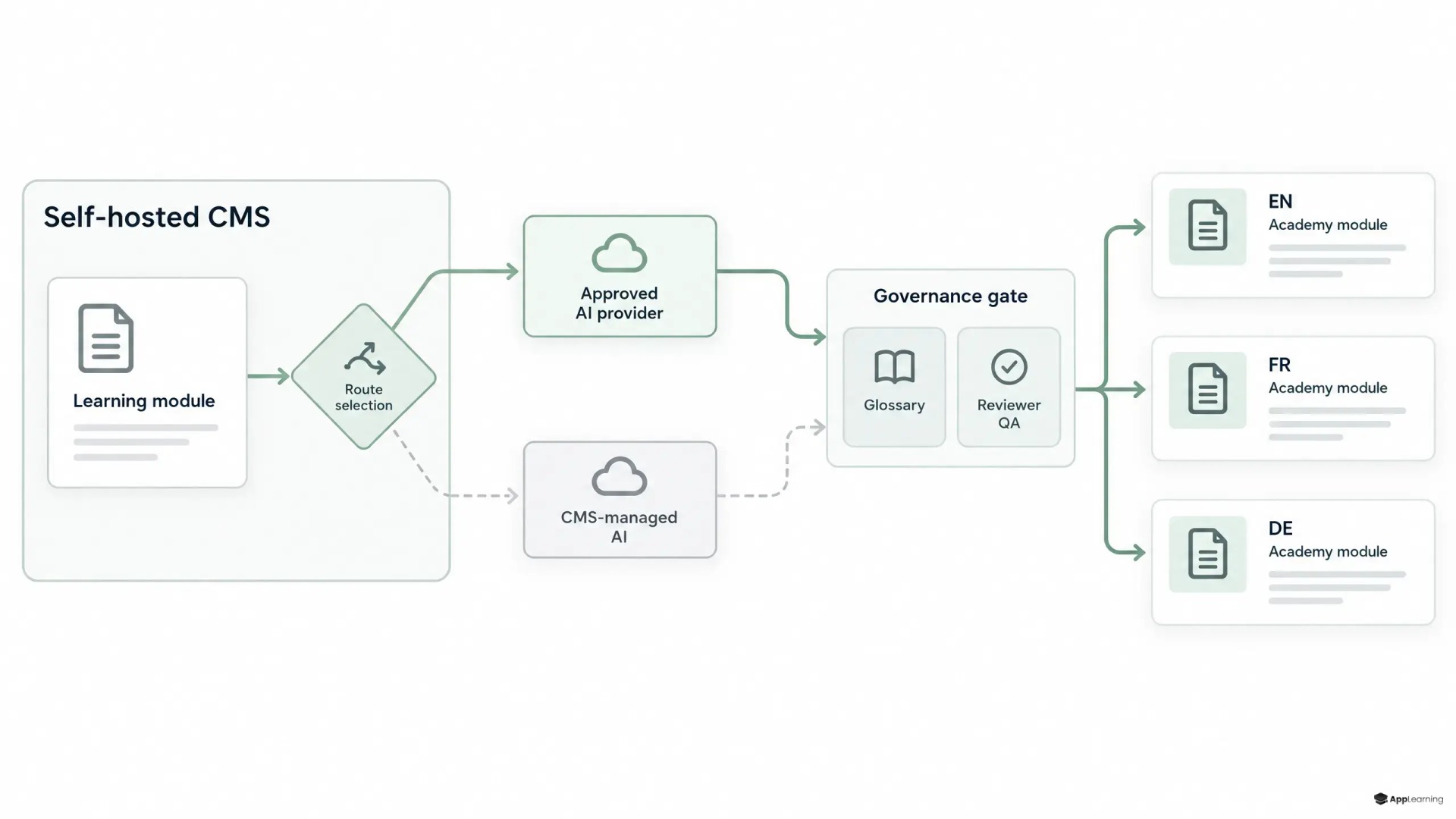
Five gates separate generation from publication
For multilingual training content, the proposed AI localization workflow should apply five gates. App-Learning’s modular authoring approach can make lessons, questions and disclosures separate reviewable units rather than one translation blob.
- Source approval. Freeze a reviewed lesson version with stable component identifiers and named owners.
- Routing approval. Send only permitted fields through the approved endpoint and record model and configuration versions.
- Terminology checks. Apply a versioned glossary, flag prohibited variants and check locale-specific financial terms.
- Specialist sign-off. Review quiz answers, explanations and risk disclosures for meaning and jurisdictional fit.
- Controlled publishing. Separate generation from publishing permissions and retain reviewer identity, changes, release version and rollback reference.
The commercial choice follows the workflow
Strapi describes Enterprise AI usage as unlimited and without credits. (strapi.io) A comparison should still budget for provider charges, review effort and maintenance.
- Native CMS add-on. A candidate when editors work inside Strapi and its translation behaviour fits the approval process.
- External agentic authoring studio. A candidate when glossary controls, validation and multi-system delivery justify owning orchestration and integration.
Strapi’s pricing page lists Enterprise AI as an add-on. (strapi.io) Procurement should obtain a written Enterprise and add-on quote before comparing total operating costs.
Migration remains a separate engineering decision
The roundup specifies Node.js 22.19.0 or later from v5.59 and flags a security fix in v5.62. (strapi.io) Those are upgrade constraints, not a migration plan. App-Learning’s deployed Strapi v4 stack does not include this v5 add-on. Compatibility, custom components, permissions and publishing behaviour would need staging tests before adoption.
Design a controlled localization pilot with App-Learning.
DiscussA bounded pilot makes the decision measurable
- Select one reviewed lesson and two target locales.
- Include ambiguous terminology, a quiz explanation and a risk disclosure.
- Measure reviewer corrections, approval time and cost per approved locale.
- Test blocked publication, source changes and rollback.
The pilot should prove secure content automation, not merely fluent output. The useful result is a traceable path from an approved source to an approved locale, with a named owner at every boundary.