

Key takeaways
- A missing completion event has several possible causes, including missing telemetry.
- Client exceptions, network failures and unacknowledged writes need separate diagnostic states.
- Release, browser and lesson-step segments are more useful than personal identity.
- Correlated errors become stronger evidence only after controlled reproduction.
- Post-fix comparisons need consistent denominators, observation windows and privacy limits.
Consider a fictional Bitcoin academy inside a fintech app. A learner taps Submit. An exception interrupts the quiz before completion is saved. The funnel records an apparent dropout. Shortening the lesson would address the wrong problem.
Web error reporting adds evidence, not intent
Firebase Crashlytics web support entered preview on November 12, 2026, with Angular, Next.js and React integrations, source maps, handled exceptions, custom keys, alerts and MCP tools. (firebase.google.com) For LMS crash monitoring, these capabilities provide diagnostic context, not proof that an error caused abandonment.
Firebase CLI 15.37.0 added filterExpression to the Crashlytics MCP get_report tool on November 18, allowing reports to be filtered by custom keys. (firebase.google.com) Teams could use approved lesson-step and release keys to narrow an investigation.
The web preview has no SLA or deprecation policy and may change incompatibly. (firebase.google.com) Its integration should therefore remain replaceable rather than define the learning event model.
Learning and reliability need one event contract
A proposed contract should use identical meanings across browser, embedded WebView and native app journeys. Each event carries a schema version, event ID, timestamp, random session-scoped identifier, session-scoped attempt ID, lesson step, content version, release and coarse platform metadata.
- lesson_start means the lesson became usable.
- quiz_submit records submission intent, without answers.
- completion_acknowledged fires only after the server confirms durable completion.
- technical_failure records a bounded category, such as client_exception, network_timeout or write_rejected.
- lesson_exit records an explicit in-product exit, not inferred intent.
A server-side persistence record supports reconciliation when acknowledgement is lost. Retried writes reuse an idempotency key; duplicate events do not become extra attempts.
A diagnostic dashboard preserves uncertainty
An illustrative dashboard could show these synthetic observations, not deployment results.
- Release r42, Safari, quiz submit — 100 attempts submitted, 80 acknowledged; 12 unacknowledged attempts include exceptions.
- Release r42, iOS app, quiz submit — 100 attempts submitted, 96 acknowledged; one unacknowledged attempt includes an exception.
The browser slice deserves investigation. The comparison does not establish equivalent audiences, telemetry coverage or a causal effect.
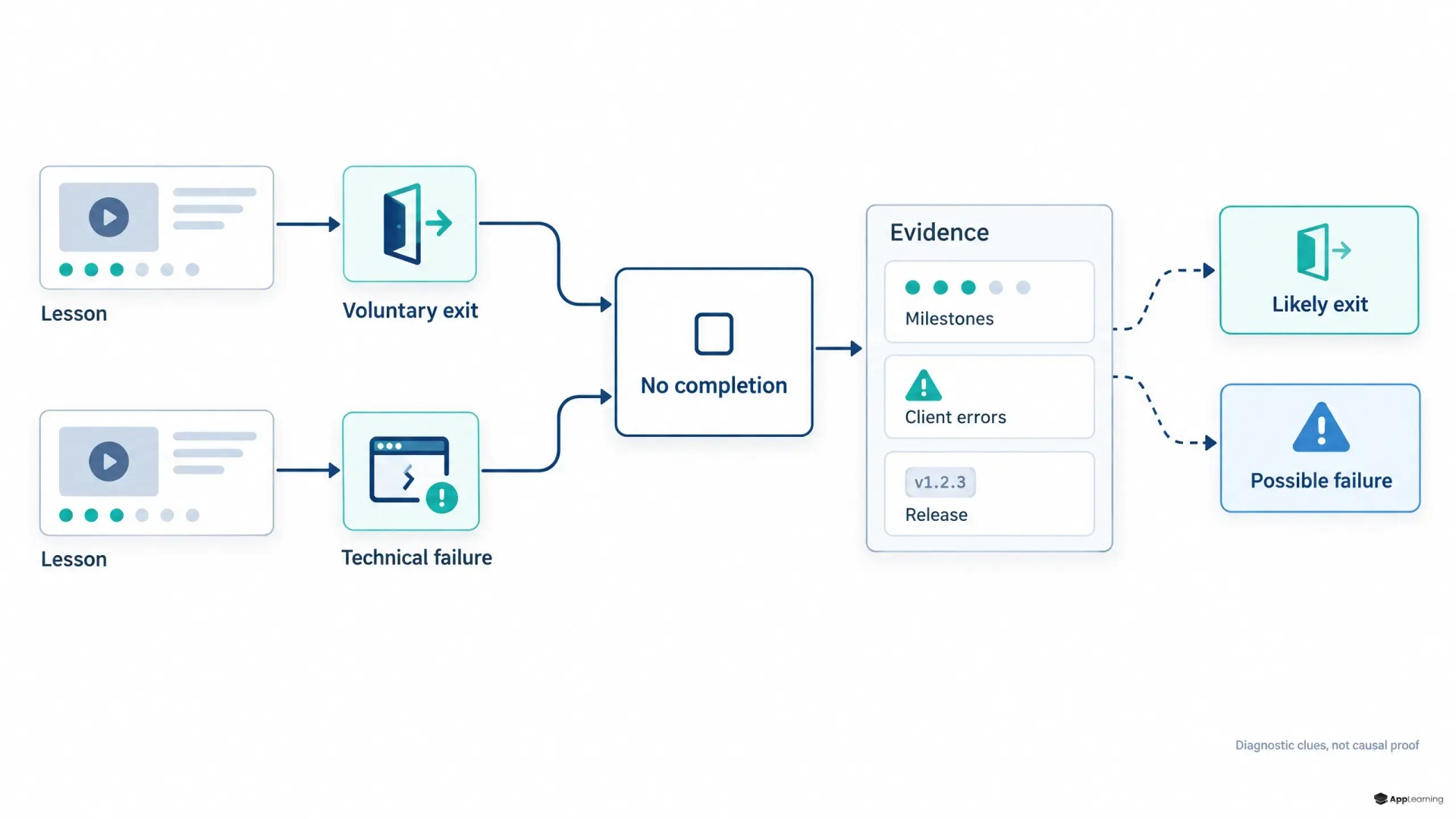
The diagnosis branches before curriculum changes
- Check server persistence first. A saved completion with no acknowledgement is a delivery or instrumentation gap.
- Inspect failures before missing completion. A timeout leaves the write outcome uncertain until reconciliation.
- Separate explicit exits from silent disappearance. Neither establishes lack of interest.
- Keep unexplained gaps unresolved. Investigate UX friction through reproduction and learner feedback.
The W3C warns that unload events may never fire when a backgrounded mobile process terminates. (w3.org) In learning analytics, dropout should therefore remain a provisional classification, not a verdict about motivation.
Embedded academy reliability needs targeted QA
The proposed test matrix crosses affected and previous releases with Safari, Chromium, Firefox, iOS and Android WebViews, and native paths. Tests cover offline submission, reconnection, blocked telemetry, denied consent, double taps and server success followed by response loss. A controlled reproduction should demonstrate the failing transition and verify recovery without duplicate completion.
Review your academy’s learning and reliability event contract with App-Learning.
DiscussPrivacy limits remain after the repair
Pseudonymisation reduces linkability but is not anonymisation. (edpb.europa.eu) The proposed implementation excludes answers, account identifiers, wallet addresses, tokens and raw URLs from logs, sanitises exception messages and limits retention and access. Collection requires privacy and consent review before SDK activation.
Post-fix monitoring should compare aggregate error prevalence and acknowledged completion across matched release cohorts, using consistent denominators, content and observation windows. Changes in consent or sampling need separate reporting. Better results support the diagnosis; before-and-after correlation alone does not establish causation.
At App-Learning, we would treat reliability as part of learning design. A broken submission is a product defect to investigate, not evidence that the learner stopped caring.