
Key takeaways
- Treat AI use as contribution discipline, not a prohibited shortcut.
- Grade explanations, test evidence, review responses and documentation above output speed.
- Require disclosure when AI materially shapes code or technical reasoning.
- Issue credentials for demonstrated contribution readiness, not completed modules.
AI Moves Into the Contributor Funnel
AI-assisted development is already part of the path into Bitcoin open source. Summer of Bitcoin’s 2026 challenge round was designed for an AI-native environment. It did not reward code generation alone. It looked for candidates who could use AI to deepen protocol understanding, validate assumptions, explain trade-offs and produce work that others could review.
That is the right signal for Bitcoin developer education. The goal is not faster output. The goal is a contributor who can be trusted with a repository, a review thread and an unfamiliar problem. On July 24, 2026, Btrust awarded $904,000 across five developer-education programs built to move learners toward meaningful Bitcoin open-source contribution. These pipelines need explicit rules for AI before learners reach maintainers.
Bitcoin Makes Review the Product
In Bitcoin open source, a contribution is more than code that compiles. It is an argument that another person can inspect. The contributor must explain the problem, scope the change, show what they tested, document the reasoning and respond to criticism. AI can accelerate parts of this work. It cannot take responsibility for it.
Bitcoin Core already makes that distinction in its AI policy. AI use is welcome when it adds value, but contributors must know the language, understand the surrounding code, explain the change in their own words and remain the human author in the loop. Autonomous agents must not drive pull requests. This is a useful baseline for any AI coding policy in Bitcoin developer training.
The wider Bitcoin Core contributor workflow sets the same standard in practice. Pull-request authors must understand and test their changes, identify the relevant tests or manual validation steps, and keep documentation aligned with changed behavior. Bitcoin raises the trust bar because review capacity is scarce and mistakes can carry durable costs.
Policy Turns AI Use Into Accountability
An academy should not ban AI tools or leave their use vague. Both approaches fail. A ban drives use underground. Silence rewards polished but poorly understood submissions. A practical AI coding policy should define the boundary between assistance and authorship.
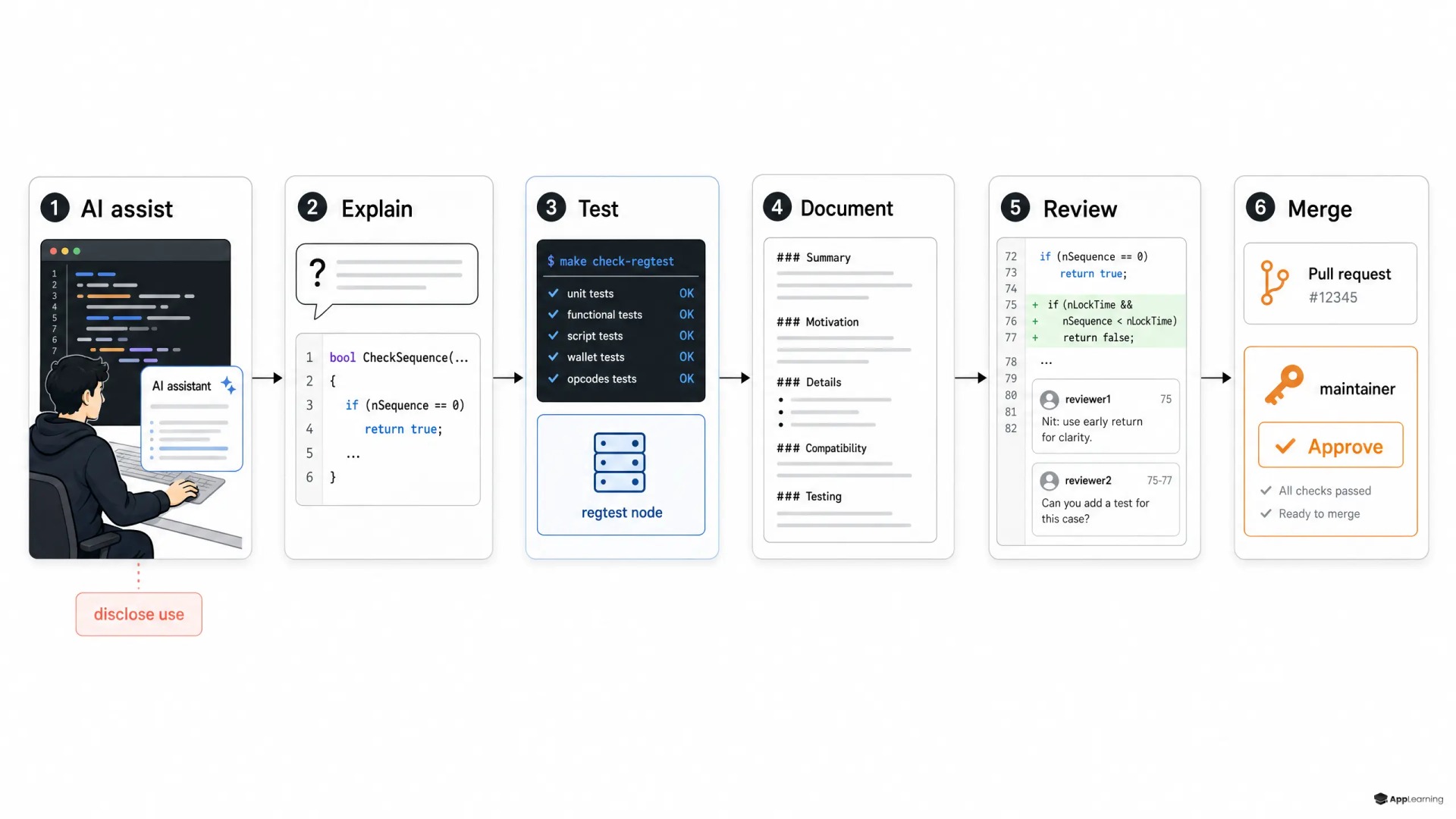
- Permit AI for explanation, research prompts, debugging hypotheses, test ideas and first-pass drafts.
- Prohibit autonomous issue filing, pull-request submission and AI-written replies to mentors or maintainers.
- Require learners to verify generated claims against code, specifications, tests and primary documentation.
- Require disclosure when AI materially shapes code, technical reasoning, test cases or submitted documentation.
- Keep responsibility with the learner for every line, dependency, command and design decision they submit.
Disclosure should be proportionate. Learners do not need to publish every prompt. They should record the tool used, the task, the material output adopted, the changes made by the learner and the validation performed. That creates useful provenance without turning a learning program into surveillance.
Good to know
Should Bitcoin developer education ban AI coding tools?
No. A blanket ban is difficult to enforce and does not prepare learners for real contribution environments. Define permitted uses, require human accountability and assess independent understanding.
What should responsible AI coding assessments measure?
Measure the learner’s reasoning, test design, validation evidence, documentation, review response and ability to explain the submitted change without relying on generated text.
When should a learner disclose AI assistance?
Disclosure is appropriate when AI materially influenced submitted code, technical reasoning, tests or documentation. The record should state what was used and how the learner validated it.
Assessment Should Expose the Work
Course quizzes cannot establish responsible AI coding. They mainly show recall. Bitcoin developer training should assess the artifacts that make a contribution reviewable. Give learners a bounded repository task, allow declared AI use, and require evidence that reveals how they reached the result.
- A short problem statement and implementation rationale written before coding.
- A focused patch with clear commits and a reviewable pull-request description.
- Tests, test results and manual validation steps tied to the change.
- A recorded walkthrough that explains dependencies, failure cases and trade-offs without AI assistance.
- A response to review feedback that accepts, rejects or revises comments with technical reasoning.
- A concise AI-use disclosure linked to the submitted work.
Add an adversarial step. Ask the learner to identify one weak assumption in an AI suggestion, explain how they detected it and show the test or source that corrected it. This tests judgment, not prompt fluency. It also builds the habit that matters most in open source: generated output is a starting point for verification, never proof.
Build contributor-ready Bitcoin learning with App-Learning.
DiscussReadiness Evidence Outlasts Completion Badges
A course-completion credential says that someone reached the end of a program. A contributor-readiness credential should say more. It should show that the learner can work within a contribution policy, write a small and testable change, document decisions, handle review and disclose material AI assistance.
For Bitcoin companies building academies, developer communities or technical onboarding, this evidence has operational value. It helps mentors focus on higher-value feedback. It gives ecosystem partners a clearer view of learner readiness. It also makes responsible AI coding a visible capability rather than an unexamined risk. App-Learning can structure these policy modules, review simulations and evidence-based assessments into a mobile-ready learning system without separating education from real contribution practice.
AI will make first drafts cheaper. It will not make independent reasoning, careful testing or maintainer trust cheap. Bitcoin developer education should teach learners to use AI openly and well, then prove they can stand behind the work when the tool is no longer in the room.