

Key takeaways
- Assisted task performance and independent understanding are distinct outcomes.
- Short unaided checks can assess foundational concepts without banning legitimate workplace AI.
- New-context scenarios assess transfer rather than recall of a worked example.
- Delayed checks deserve priority where errors carry serious consequences.
- One experiment cannot establish an absence of learning across all AI tools and tasks.
The October study separates output from understanding
In their published abstract, (pubmed.ncbi.nlm.nih.gov) Wiles and colleagues report a randomized trial of 487 management consultants. Their Nature Human Behaviour paper appeared on October 26, 2026. ChatGPT access and training improved scores on three unfamiliar data-science tasks. The researchers found no evidence of better post-experiment technical-question performance without ChatGPT. Better assisted output did not establish better independent knowledge.
According to the publisher’s disclosures, (nature.com) authors had BCG and OpenAI affiliations, Wiles received BCG consulting fees, and BCG supplied employee time and resources. The finding does not establish durable skill loss or exclude learning with other tools, tasks or instruction. The assessment design below is a proposal, not a method validated by this study.
Three outcomes need different evidence
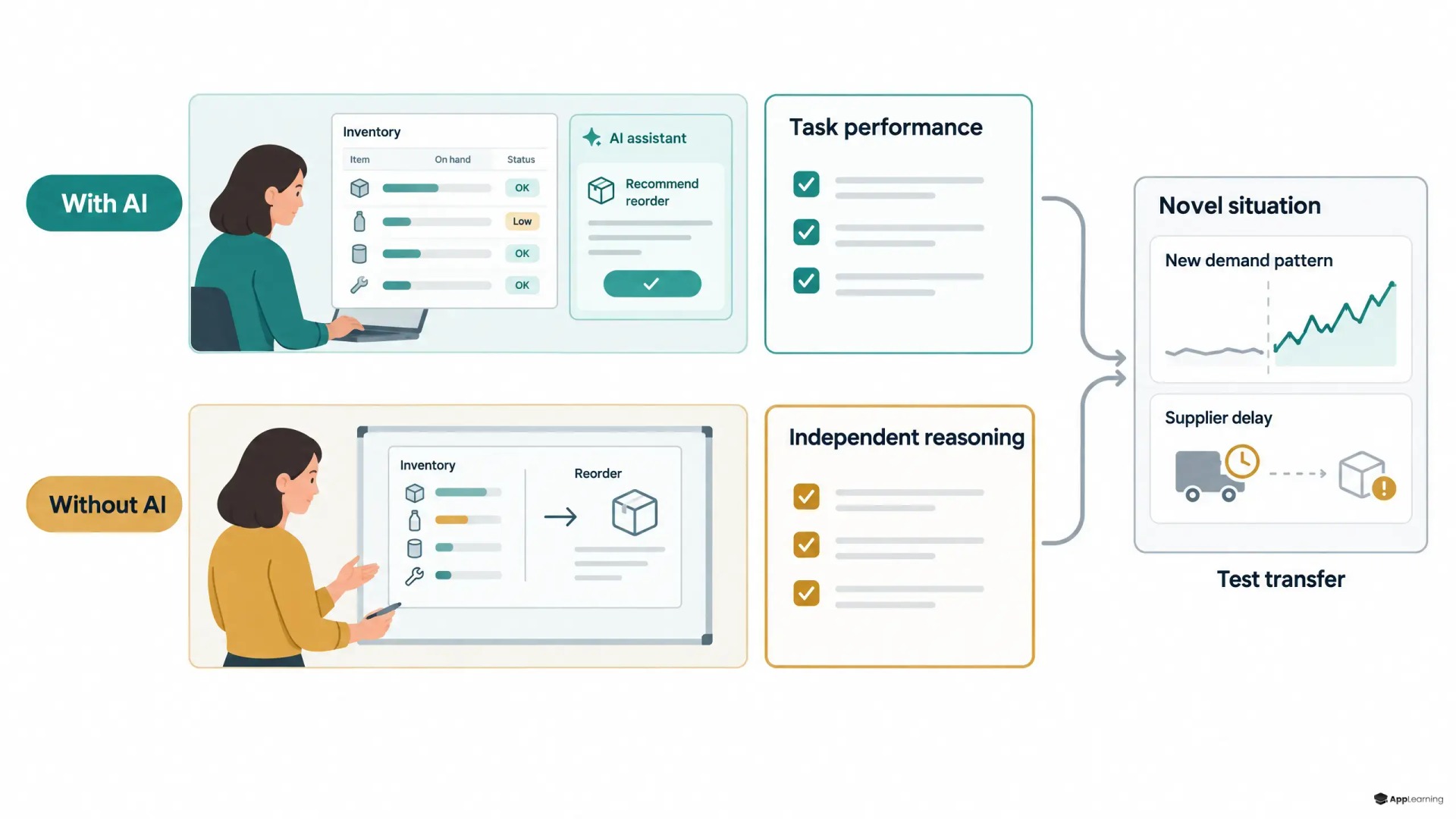
An AI upskilling assessment should distinguish assisted performance, independent knowledge and transfer. Assisted performance concerns work completed with approved tools. Independent knowledge concerns what employees can explain unaided; evidence of acquisition requires comparison with a baseline. Transfer concerns applying that understanding when important conditions change. One completion badge should not stand for all three.
Two assessment modes preserve real work
The practical response to AI-assisted performance versus learning is a paired assessment with explicit tool conditions.
- AI-enabled task. Complete a realistic assignment using an approved model and normal reference materials in a sandbox. Submit the result, supporting evidence and verification notes.
- Unaided check. Explain a foundational concept, identify a flaw in a supplied result and justify an escalation decision without AI, chat history or reference materials.
In an App-Learning academy design, corporate microlearning would support the knowledge component through short mobile lessons and retrieval questions. Scenario-based assessments would test explanation and verification. The independent knowledge assessment should target reasoning, not recall of obscure policy codes.
A banking case exposes unsupported confidence
Consider an illustrative payment-exception exercise using synthetic records. An AI-generated draft recommends release because two customer names match, although their identifiers differ. The exercise policy requires specialist review of unresolved identity mismatches. In assisted mode, the employee checks the records, corrects the recommendation and documents the handoff. Unaided, they explain why the name match was insufficient.
A proposed rubric scores each dimension from zero to two, with anchors for unsafe or missing, incomplete, and correct evidence-based responses.
- Assisted accuracy assesses whether the recommendation follows the exercise policy.
- Verification assesses whether the employee checks the underlying identifiers.
- Unaided reasoning assesses whether the employee explains the evidential gap.
- Transfer assesses whether the employee handles a different mismatch and identifies the appropriate specialist handoff.
A missed mandatory escalation should block a readiness decision regardless of the total score. These are proposed exercise rules, not banking regulations.
The dashboard keeps competence dimensions separate
Reporting should retain separate fields for assisted delivery, verification, unaided reasoning and transfer. High assisted scores with weak explanation would trigger focused practice rather than an automatic readiness badge. For high-consequence decisions, a fresh scenario after an agreed delay would check retained understanding. Tool, task and policy versions belong beside the results.
Build a pilot that separates assisted delivery from independent understanding.
DiscussA narrow pilot makes the decision testable
A practical pilot would cover one role and workflow. Operations and compliance owners would approve the cases, scoring anchors and readiness thresholds before launch. Parallel baseline and post-training checks would track change; reviewers would double-score a sample. Without a comparison group, reporting should describe score changes rather than claim causal training impact.
The pilot deserves expansion only if scoring is consistent, assessment effort is workable and results guide support decisions. The goal is not work without AI. It is a defensible account of what employees can deliver with assistance, explain independently and carry into the next unfamiliar case.