

Key takeaways
- Research capability and everyday safe-use literacy require different learning paths.
- Role-based AI upskilling connects approved tools to specific workplace decisions.
- Central governance and local-language practice need shared version control.
- Decision simulations reveal judgement that course completions cannot show.
- Announced training reach is not evidence of learning impact or financial return.
An institute and a workforce need different systems
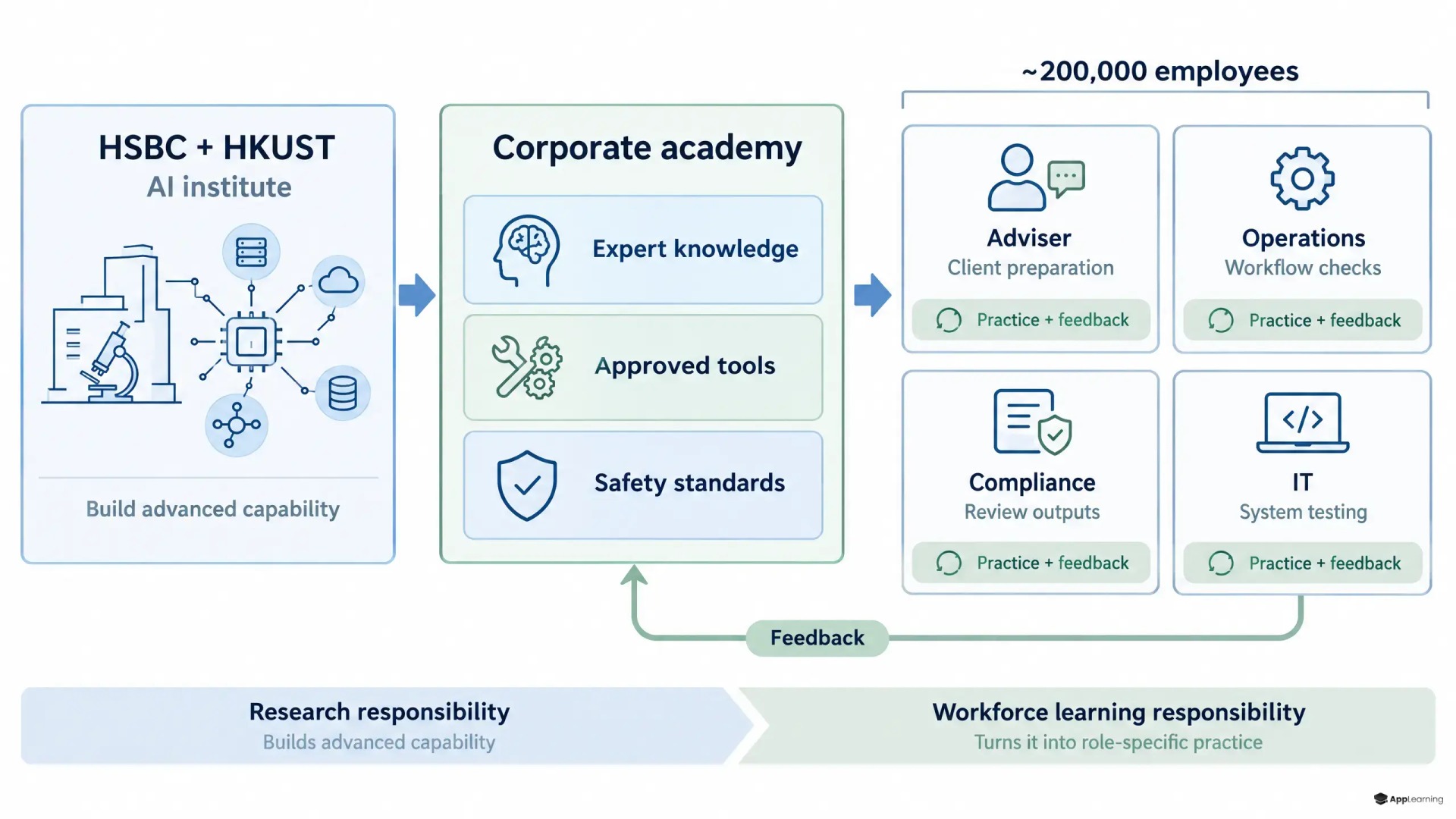
On 2 November 2026, HSBC announced plans for a Hong Kong AI and Emerging Technology Institute, with the Hong Kong University of Science and Technology as its anchor academic partner. (about.hsbc.com.hk) That creates a route for research and technology development, but does not itself explain how employees will learn to use the resulting systems.
Reuters reported a target opening in the first quarter of 2027 and an AI-training rollout covering roughly 200,000 employees worldwide. (businesstimes.com.sg) These are plans and rollout statements, not evidence of completed training, safer decisions or financial returns.
Expertise needs a route into everyday decisions
Advanced specialists and everyday users have different responsibilities. An engineer might evaluate system behaviour; a branch adviser needs to recognise when a customer summary is wrong. AI training for bank employees should share a safety foundation without treating those tasks as interchangeable.
NIST’s AI Risk Management Framework links training to people’s duties, policies and responsibilities. (airc.nist.gov) A corporate AI academy should translate that principle into relevant practice, not distribute one uniform course. The following architecture is an illustrative App-Learning use case, not a description of HSBC’s internal programme.
Four layers connect policy to performance
- Foundation modules establish approved systems, permitted data, output-checking responsibilities and escalation routes.
- Role modules give advisers customer-summary checks, operations teams exception cases, support teams response drafts, risk teams control reviews and IT teams access-management scenarios.
- Supervised practice follows awareness modules with short decision simulations, explanatory feedback and manager-reviewed exercises using synthetic data.
- Contextual updates provide brief refreshers when a tool, workflow or policy changes, with reassessment where the change affects decisions.
In this proposed white-label academy, experts maintain the approved knowledge while L&D turns it into tasks. Risk and process owners approve the decision rules. The academy sits alongside access controls and supervision; passing a module does not, by itself, authorise tool use.
A customer summary makes judgement observable
Consider a fictional exercise in which an approved assistant generates a customer-meeting summary. It invents an income figure and omits an unresolved concern. The learner receives the original notes and must decide whether to accept, correct, withhold or escalate the draft.
The scoring should follow the supplied policy and workflow. It should reward checking the source, removing unsupported statements and choosing the appropriate follow-up—not escalating every case. Feedback explains the consequence of each choice. A later variation tests the same judgement without repeating the answer.
Local deployment needs controlled variation
The proposed governance model keeps approved examples, policy references, assessment rules and content versions central. Local teams adapt language, customer context and applicable procedures through named reviewers. Each variant retains an owner, approval date and link to its source. A central change should flag affected variants for review rather than silently overwrite them. This makes bank workforce enablement a maintained process, not a translation project.
Build a role-based AI learning pilot with App-Learning.
DiscussA narrow pilot earns the case for scale
A pragmatic pilot could cover one approved tool, one workflow and two roles. Baseline and follow-up assessments should use equivalent scenarios. Measures should include correct decisions, missed risks, unnecessary escalation and retained judgement after several weeks. Completions remain useful as coverage data.
Where permitted, sampled work reviews and aggregate approved-tool usage could test whether learning transfers into practice. Any return estimate should account for review effort and rework, rather than assume that time saved equals value delivered.
The bridge from an AI institute to a branch is not a shorter research presentation. It is a maintained chain from expert knowledge to approved tasks, realistic practice and observable decisions. That is the standard an internal academy should be designed to meet—and a pilot should test before expansion.