

Key takeaways
- Quantum readiness is a research problem and a knowledge-distribution problem.
- Developers, custody teams, product leads, and executives need different cryptographic depth.
- Premature alarm and delayed preparation both damage customer trust.
- Versioned learning paths keep organizations aligned as evidence and proposals evolve.
The risk needs precision, not panic
Bitcoin quantum readiness starts with a clear threat model. A sufficiently capable quantum computer could derive private keys from exposed public keys protected by Bitcoin’s elliptic-curve signatures. That does not mean every bitcoin is equally exposed, that a capable machine exists today, or that Bitcoin mining suddenly becomes obsolete. Bitcoin Optech’s overview of quantum resistance also notes that post-quantum signature alternatives bring significant key and signature-size trade-offs.
For a product lead, the operational point is simple. Do not turn an uncertain technical timeline into a permanent customer alarm. Do not treat uncertainty as permission to wait either. The real work is to establish decision triggers, identify affected product surfaces, and prepare the organization to act when the protocol, wallet, custody, or regulatory environment makes action necessary.
Grants build solutions, not shared readiness
Research funding is necessary. Galaxy’s program combines grants with research and expert review, which is the right response to a problem that spans cryptography, protocol design, and coordination. But a new signature scheme or Bitcoin Improvement Proposal does not automatically become a product requirement, a custody procedure, or a customer-safe explanation.
The education gap is already visible in Bitcoin development more broadly. On July 24, 2026, Btrust awarded US$904,000 across five developer-education initiatives built around structured pathways, mentorship, projects, and routes into open-source contribution. Quantum readiness needs the same discipline, but it must extend beyond protocol contributors.
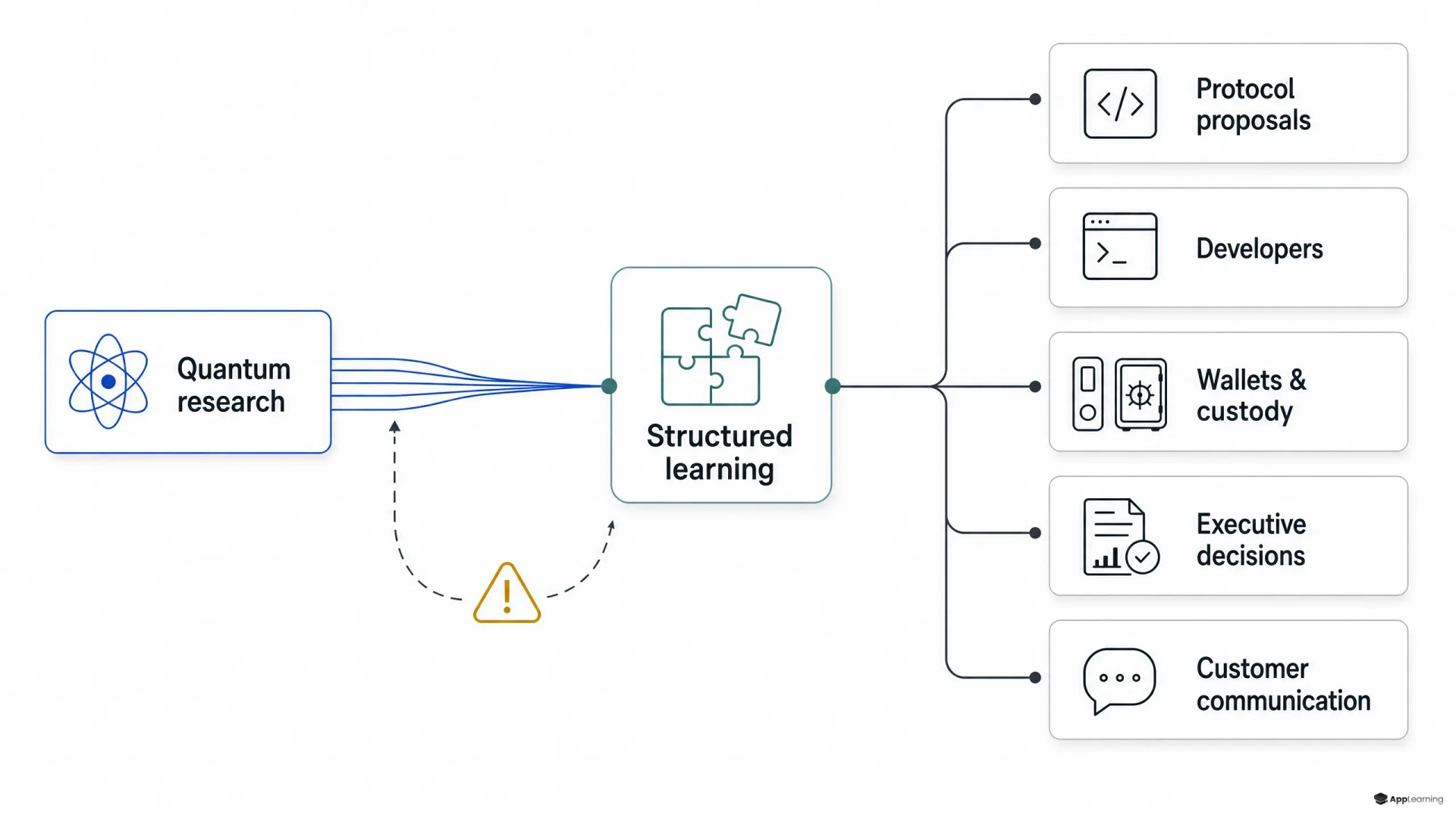
Without that translation layer, technical knowledge stays concentrated among a small group of specialists. Product teams then receive fragmented updates, support teams hear customer fears before they have approved answers, and executives face migration decisions without a common operating model.
Different roles need different proofs of understanding
A single post-quantum Bitcoin education course will fail. It will either oversimplify the engineering work or bury decision-makers in detail they cannot use. A Bitcoin technical academy should create role-specific paths with a shared baseline on the threat, uncertainty, and governance constraints.
- Protocol and infrastructure developers need cryptographic primitives, signature trade-offs, validation implications, test environments, and proposal review.
- Wallet and custody teams need UTXO exposure analysis, signing architecture, key-management controls, migration flows, and incident playbooks.
- Product leads need decision triggers, dependency maps, user-journey changes, rollout criteria, and measurable trust risks.
- Compliance, support, marketing, and leadership need scenario literacy, approved language, escalation paths, and clear boundaries on what can be promised.
Research must become product decisions
Post-quantum Bitcoin education should follow a translation chain. Begin with the research signal. Define the operating decision it may require. Convert that decision into product and security requirements. Then prepare the customer communication that applies only when an actual change affects users.
This avoids two common failures. The first is publishing technical news that users cannot act on. The second is discovering too late that a protocol change affects address handling, transaction size, hardware-wallet support, custody workflows, recovery procedures, or support scripts. The wider cryptography field has standards to draw from: NIST finalized its first principal post-quantum standards in 2024, but Bitcoin still requires protocol-specific choices and ecosystem coordination.
Good to know
Does quantum computing threaten Bitcoin today?
No cryptographically relevant quantum computer is known to exist today. The current task is to prepare for a credible future migration without presenting uncertainty as an immediate user emergency.
Do all Bitcoin employees need cryptography training?
No. Every relevant team needs a common risk baseline, but only technical roles need deep instruction on signature schemes, protocol proposals, and implementation trade-offs.
Should product teams communicate quantum risk to every customer now?
Not as a generic warning. Customer education should be tied to a concrete product change, required action, or security decision that affects the user.
A readiness academy should behave like a release system
The academy needs version control. Evidence will change. Technical proposals may change. The likely migration path may change. Each learning module should therefore show its status, owner, review date, confidence level, and the decision it informs. Short updates should replace large annual compliance courses.
A practical program contains a common risk primer, role-based technical modules, scenario exercises, migration decision trees, customer-communication templates, and assessments tied to real responsibilities. Product teams should also separate internal readiness from retail education. Most users do not need a cryptography course. They need clear, contextual guidance when a wallet flow, security setting, or required action changes.
Build a Bitcoin learning system that keeps product, security, and customer teams aligned.
Talk to usLearning becomes part of Bitcoin security operations
App-Learning can help Bitcoin companies turn this material into a mobile-first, role-specific curriculum that evolves with the evidence. Internal paths can prepare product, security, custody, and support teams. Embedded product education can then explain concrete changes at the moment users need to understand them, with localized modules and measurable completion data.
Bitcoin quantum readiness will not be achieved when a grant is announced or a technical proposal is published. It will be achieved when the people who build, govern, operate, explain, and use Bitcoin can make sound decisions from the same evolving body of evidence. That makes post-quantum Bitcoin education a security capability, not a communications add-on.