
Key takeaways
- Microlearning alone does not create workforce transformation.
- Its power comes from the system around it.
- Repetition and workflow fit drive lasting skill change.
- Small learning units can support large capability shifts.
Microlearning only looks small if you judge it by lesson size instead of system impact. That is where most workforce teams get trapped. They defend the format as fast, flexible, and learner-friendly, while critics judge it against the wrong standard: whether a two-minute lesson can replace a full program on its own. Of course it cannot. The real question is whether small learning moments can move people through a role change, reinforce critical decisions, and hold new behavior in place long enough to become operating habit.
Microlearning breaks when it is just compressed content
The skepticism is not irrational. A systematic review of microlearning interventions found stronger evidence for cognitive gains than for behavior change, and it noted that sequence-based microcontent performed better than one-off interventions. That matches what enablement teams see in practice. If microlearning is used as a smaller wrapper around generic information, it usually produces awareness, not transformation.
This is the most common failure pattern: a long course gets sliced into shorter assets, pushed into an LMS or app, and then measured by opens, views, and completion. The lesson is smaller, but the learning system is unchanged. There is still no real proficiency signal, no repetition logic, no manager reinforcement, and no operational checkpoint where the learner has to prove better judgment on the job.
- Content is reduced in size, but not redesigned for a specific job decision.
- Assessment checks recall of information, not performance in context.
- Lessons are delivered once instead of repeated across the adoption window.
- Learning is separated from workflow, so application depends on memory and goodwill.
- Teams report engagement metrics because capability metrics were never designed.
Transformation starts when small lessons are tied to larger role change
That does not make microlearning weak. It defines its job. Spacing research that synthesized more than 400 distributed-practice reports and an 18-month randomized study with practicing physicians point in the same direction: short retrieval events repeated over time improve retention, and well-structured repetition can also improve transfer. That is exactly where microlearning earns its place in workforce transformation.
When a business is changing tools, processes, product lines, compliance requirements, or frontline behaviors, people do not fail because they never saw the material. They fail because they cannot recall the right move at the right moment, under time pressure, inside a live workflow. Microlearning works here because it can sit in the cadence of work. It can prepare a role transition, reinforce a new standard, challenge a decision pattern, or resurface the one rule that prevents an expensive error.
In other words, microlearning is not the transformation. It is the delivery layer that keeps transformation active between formal training, manager coaching, and real task execution. Large courses still matter for orientation, depth, and complex model-building. Microlearning becomes powerful when it carries the repetition, prompting, and proof that make those larger investments stick.
System design decides whether the format creates capability
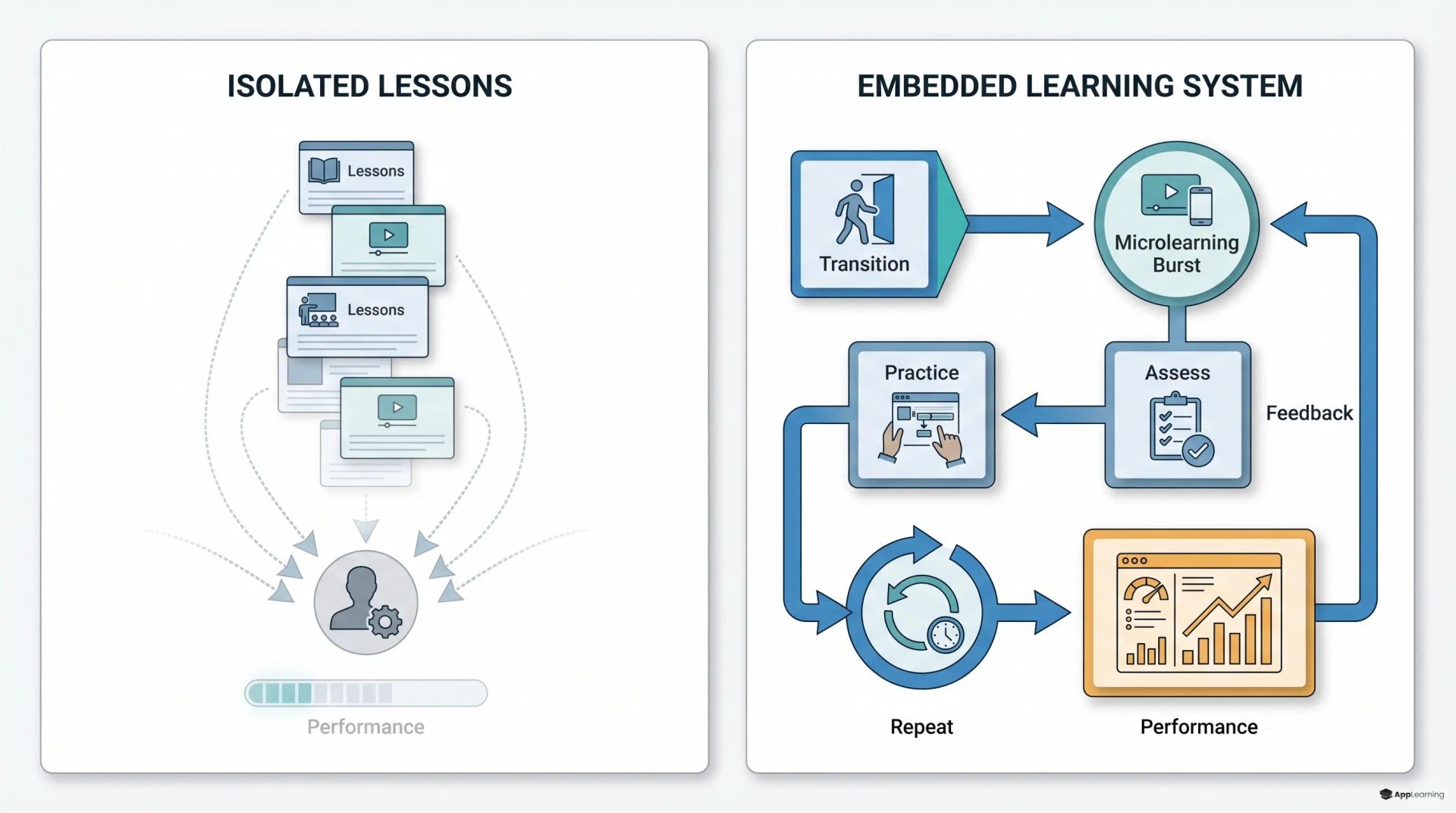
This is where the conversation has to move from content design to system design. A meta-analytic review of training transfer and later workplace-environment research on transfer show that support, opportunity to apply, and transfer climate shape whether training shows up on the job. That means microlearning becomes strategically useful only when the surrounding operating conditions are built for application.
For enablement teams, the essential design question is not "How short should this lesson be" but "What system event should this lesson support". Once that shift happens, lesson size becomes secondary to timing, trigger logic, assessment, and reinforcement.
- Map each microlearning unit to a role transition, workflow step, or decision pattern.
- Use retrieval, scenario judgment, and short practice loops instead of passive consumption.
- Schedule repetition across the period when new behavior is most likely to decay.
- Tie learning prompts to manager expectations, field coaching, or operational milestones.
- Measure time to proficiency, error reduction, adoption, and task quality rather than completion alone.
Good to know
Where should microlearning sit inside a transformation effort?
Place it around the moments where behavior must change: before a new workflow goes live, during early task execution, after errors or misses, and across the reinforcement window that follows formal training.
What should enablement teams measure first?
Start with proof of application. Track time to proficiency, performance on short scenario checks, repeat error rates, manager observations, and adoption of the new workflow or standard.
When is microlearning the wrong format?
It is the wrong lead format when people need deep conceptual grounding, extended practice, certification prep, or facilitated discussion. In those cases, microlearning works better as reinforcement than as the primary learning experience.
Enablement teams need an operating model, not a content factory
This changes the enablement brief. The job is no longer to publish a library of short assets and hope usage follows. The job is to design a capability system around business change. That means identifying the moments where people stall, the judgments they must make, the evidence that competence has improved, and the repetition pattern required to keep performance from slipping back.
Assessment logic is the hinge. If microlearning never asks the learner to retrieve, discriminate, choose, or perform against a role-relevant standard, it stays informational. The moment each unit is connected to a proficiency signal, it starts acting like infrastructure. That is also where App-Learning has a clear role: not as a prettier content container, but as the app-based layer that can deliver timely practice, collect repeated evidence, and keep learning close to execution.
For transformation programs, this is the practical reframing: use formal learning to build the model, use managers to reinforce expectations, and use microlearning to sustain action where behavior is won or lost. That is a far stronger operating logic than asking whether short lessons are inherently powerful.
See how App Learning supports role-based capability building.
ExploreFrom snackable content to strategic capability
Microlearning does not become transformational because it is brief. It becomes transformational when brevity is used with discipline inside a larger performance system. Once it is embedded in role transitions, assessment logic, workflow timing, and repeated application, its size stops being the story. What matters then is system impact: whether small learning moments reliably produce better decisions, faster proficiency, and more durable capability across the workforce.