


Key takeaways
- Skills lose value when they cannot move across employers and systems.
- Portability improves mobility, recruiting speed, and internal talent matching.
- Digital evidence matters more when work changes faster than degree cycles.
- Fragmented qualification systems create friction even when capability already exists.
Another degree can still signal quality. But in a labor market defined by faster role change, cross-functional work, and uneven hiring standards, a broad credential often arrives too slowly and says too little. The harder problem is portability: whether a skill learned in one context can be understood, trusted, and applied in another.
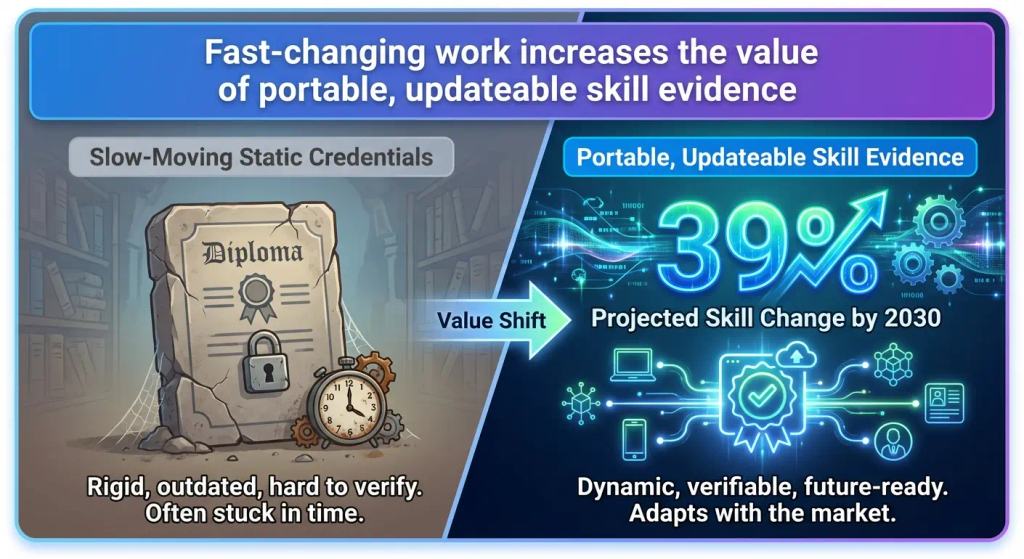
That matters because the shelf life of static credentials is shortening. The World Economic Forum’s Future of Jobs Report 2025 says employers expect 39% of key skills to change by 2030. If work is shifting that quickly, leaders need systems that make capability visible and transferable, not just systems that issue more certificates.
The credential problem is becoming structural
Degrees were built to summarize long periods of study. They were not built to document fast, modular, job-adjacent capability growth inside companies, bootcamps, apprenticeships, short courses, or AI-supported learning flows. That leaves employers with a signaling problem: they can see pedigree, but not always current ability.
This is the core shift behind the OECD’s recent work on skills signalling, which connects better skill visibility to labor market efficiency and workforce mobility. Leaders feel this directly as slower hiring, weaker internal mobility, and too much dependence on proxies like prior employer, degree brand, or job title.
Portability turns learning into labor market currency
Skills portability means more than storing a badge in a wallet. It means the skill can be described in a common language, tied to evidence, verified by another party, and understood outside the original learning environment. When those conditions hold, learning can travel across teams, employers, platforms, and borders.
The ILO’s work on skills passports and logbooks makes the practical point clearly: trusted records of skills and qualifications improve transparency, support recognition, and can reduce overqualification when workers move across labor markets. Portability is not a nice-to-have layer on top of learning. It is what turns learning into something the market can actually use.
Fragmentation is where skill value gets lost
Most organizations do not suffer from a total lack of learning. They suffer from disconnected systems. Content sits in one platform. Assessment sits somewhere else. HR systems store job architecture in another format. External credentials follow different taxonomies again. The result is friction at every handoff.
That is why the EU’s approach to micro-credentials puts so much emphasis on quality, transparency, comparability, recognition, and portability. Without common standards, the market gets more credentials but not more clarity. Learners collect proof. Employers still cannot compare it. Mobility stays slow.
- A learner completes relevant training, but the output is not mapped to a usable skill framework.
- An employer sees a certificate, but cannot verify what was assessed and at what level.
- A manager wants internal mobility, but job architecture and learning evidence do not connect.
- A worker changes country or sector, but prior learning has to be reinterpreted from scratch.
Digital evidence is the missing layer between content and hiring
Portability improves when evidence becomes digital, structured, and verifiable. That is the real promise of digital credentials. Not prettier PDFs, but machine-readable proof that can be stored, shared, and checked across systems.
The Europass European Digital Credentials infrastructure is useful here because it shows what a public interoperability layer looks like in practice: credentials can be created, issued, stored, shared, and verified in a common framework. The important lesson for leaders is broader than Europe. If your learning evidence cannot move between systems, your learning investment remains trapped inside the issuing platform.
This is where the App Learning angle becomes operational. App-Learning can bridge content, assessment, and portable skill evidence by designing learning flows that end in usable proof, not just completion data. That means mapping learning objects to skill statements, attaching assessment logic, and generating evidence that can feed talent systems rather than disappearing inside a course archive.
See how App Learning can make skill evidence usable beyond the course.
Explore App LearningA company system that makes skills travel
The practical move is not to replace degrees with chaos. It is to build a second layer of capability infrastructure around them. Leaders should treat portability as a design requirement across learning, assessment, workforce planning, and hiring.
- Define a company skill language that can connect learning content, roles, and assessment.
- Separate seat time from demonstrated capability so evidence reflects actual performance.
- Issue digital records with enough metadata to verify what was learned, how it was assessed, and at what level.
- Map external and internal credentials into one comparison layer for recruiting and internal mobility.
- Make skill evidence readable by managers and machines, not only by learning teams.
The organizations that win this shift will not be the ones that simply fund more courses or reimburse more degrees. They will be the ones that make capability legible across contexts. Learning creates strategic value only when it survives the handoff from provider to employer, from team to team, and from one labor market to the next. Portability is what makes that handoff work.
Good to know
What is skills portability in practical terms?
It is the ability to take proof of capability from one context and have it understood, trusted, and reused in another. That usually requires shared skill definitions, credible assessment, and digital evidence that can be verified.
Does this mean degrees no longer matter?
No. Degrees still matter, especially for regulated professions and broad academic signaling. The point is that degrees alone are often too coarse to support faster hiring, internal mobility, and cross-system comparison.
What should leaders change first?
Start by connecting learning outcomes to a skill framework and to assessment evidence. Once that layer exists, digital credentials and portability become an infrastructure decision instead of a branding exercise.