


Key takeaways
- AI rollout without training creates more variation across locations.
- Start with narrow, repeatable frontline workflows before broader AI adoption.
- Manager enablement is the lever that turns software into execution.
- Measure location-level behavior before you measure business outcomes.
AI has reached the store floor
When NRF Nexus 2026 made agentic AI a central theme for retail leaders and Target rolled Store Companion out to team members across nearly 2,000 stores, it became clear that AI had moved from innovation decks into frontline execution. For franchise networks, that changes the question. The issue is no longer whether AI belongs in operations. The issue is whether every location can use it the same way.
That matters more in franchising than in centralized retail. Corporate can approve one platform, but value is created or lost in hundreds of local handoffs. If one store uses AI to tighten scheduling, answer service questions, or support managers while another store improvises, the network does not scale intelligence. It scales inconsistency.
The first failure mode is local improvisation
The National Restaurant Association says workforce technology pays off when it supports quick hiring, effective onboarding, and successful training. That is the right frame for AI rollout. The first problem is usually not model quality. It is that every manager explains the new workflow differently, sets different approval rules, and tolerates different workarounds.
The pressure is real across distributed restaurant systems. At NRF 2026, Dine Brands said intelligent assistance helped it resolve franchise support tickets 34% faster. Faster support is useful, but it does not remove the execution problem inside the store. Teams still need a common way to use the tool, validate outputs, escalate edge cases, and recover when the answer is wrong.
Narrow use cases win first
The strongest first wave of frontline AI is operationally narrow. In the National Restaurant Association’s Technology Landscape Report, 37% of operators said they planned to invest in automated recruitment and scheduling systems, while 16% planned AI integration. That pattern still holds. Start where the task repeats, the decision rules are visible, and the team can tell quickly whether the output helped.
The live examples follow that logic. Walmart’s frontline AI tools focus on task guidance, translation, and simpler work planning, while Yum China says it uses AI to support demand forecasting, crew scheduling, and frontline manager productivity. These are not moonshot use cases. They remove friction from repetitive store decisions.
- Scheduling and labor balancing
- Shift task prioritization at open, peak, and close
- Service and policy answers for frontline teams
- Manager support for approvals, exceptions, and tickets
- Compliance and execution checks tied to standard routines
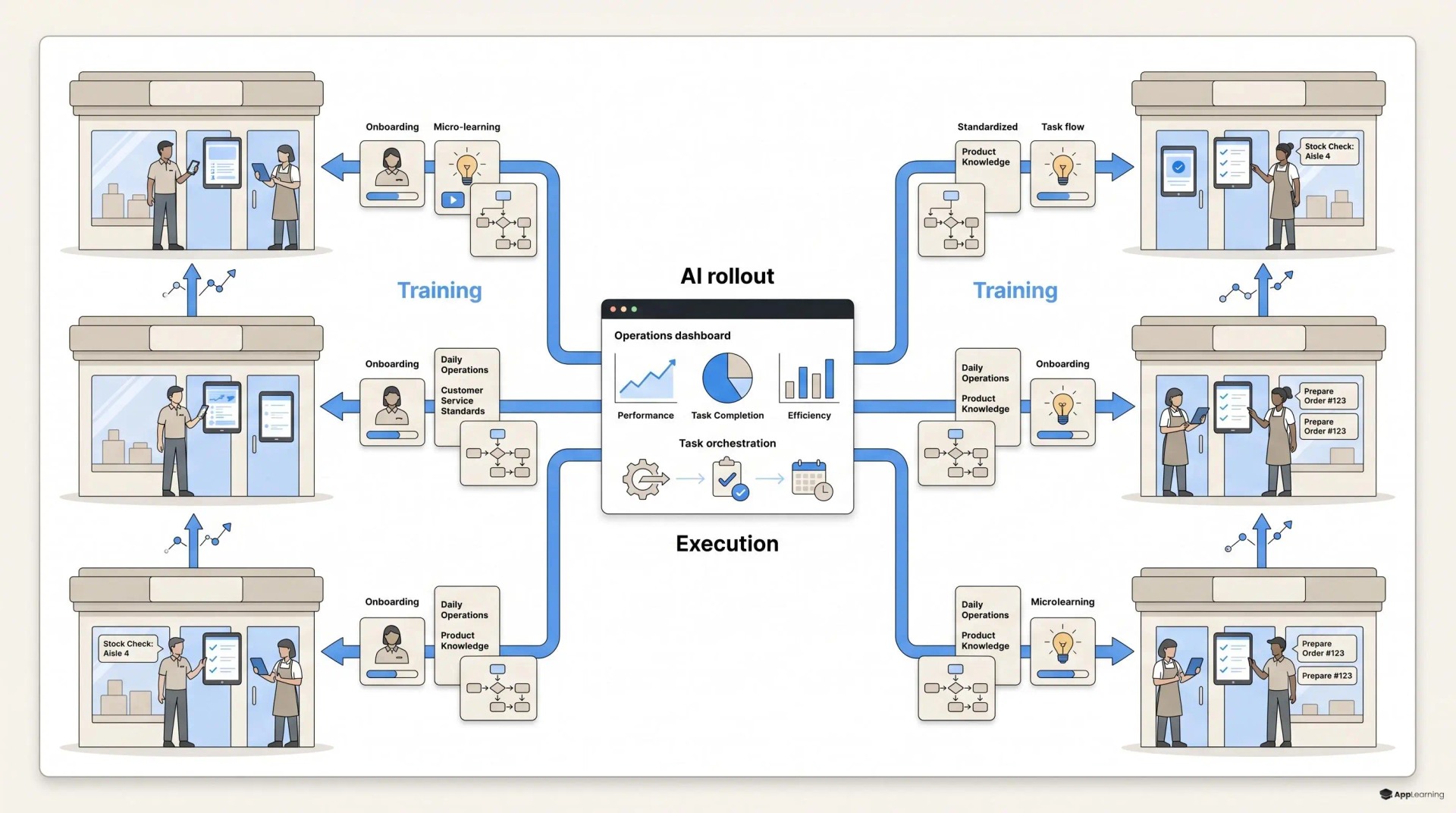
Training is the control layer
The common mistake is to launch the tool and call that rollout. Franchise systems need a control layer around the tool: who uses it, for which task, with what input structure, under which approval rule, and with what fallback when the output is weak. That control layer is training. Without it, AI becomes one more source of local interpretation.
For frontline teams, the format has to match the operating reality. Short mobile learning works because it can fit into shift transitions, pre-opening routines, launch weeks, and manager huddles. The aim is not broad AI literacy. The aim is reliable behavior at the point of work.
- Define a small set of role-specific AI workflows before launch
- Write the approved prompts, inputs, and escalation rules into the playbook
- Train managers first on coaching, approval, and exception handling
- Deliver short employee modules tied to one task at a time
- Pilot in a small region and lock the standard before network rollout
- Update training whenever the tool, policy, or workflow changes
Good to know
Where should a franchise network start with frontline AI?
Start with one repetitive workflow that already has a clear standard operating procedure and a visible pain point. Scheduling, task prioritization, and service knowledge are usually better entry points than broad open-ended use.
Who should be trained first in an AI rollout?
Train district leaders and store managers first. They set the usage rules, coach exceptions, and decide whether the new workflow becomes standard or optional.
How long should frontline AI training be?
Keep employee training short and task-specific. If a lesson cannot be applied on the next shift, it is probably too broad for a frontline rollout.
What should success look like in the first 30 days?
Success starts with consistent manager certification, employee completion, and active use on the target task by location. Only after that should you expect reliable movement in labor, speed, accuracy, or service metrics.
Measure behavior before results
Most networks measure the wrong thing after launch. Logins and licenses tell you whether access exists. They do not tell you whether the new workflow is actually being executed consistently from one location to the next. Adoption in a franchise system has to be measured at store level, not just at platform level.
- Manager certification by location
- Employee completion within the launch window
- First-task usage on the target workflow
- Exception and escalation rates
- Time saved on the specific task
- Service, labor, or accuracy gains linked to trained behavior
This order matters. First prove the behavior changed. Then look for labor efficiency, speed, accuracy, upsell, or guest experience gains. If outcomes move without adoption data, you cannot tell whether the tool worked or whether a handful of strong operators pulled the average up.
See how App Learning standardizes AI rollout across every location.
ExploreThe rollout system needs a learning layer
The long-term upside is not just local productivity. In its 2024 annual report, Yum China says AI-enabled digital tools help capable managers oversee multiple stores without compromising quality. That is the strategic benchmark for franchise operators. AI becomes valuable when it increases span of control without reducing standards.
App-Learning supports that shift by turning new workflows into short, role-based, mobile training that can be launched centrally and executed locally. Instead of pushing software into the field and hoping managers translate it, operations teams can deploy one playbook, sequence rollout by role, and see where adoption is slipping before inconsistency shows up in service or execution.
Franchise leaders will get more value from AI by treating rollout as an execution design problem. The tool matters, but repeatability matters more. In distributed operations, the real edge is not buying AI first. It is making sure every store runs the new workflow the same way when the next shift starts.