

Key takeaways
- Complex onboarding needs trust and clarity, not only cleaner forms.
- Users need preparation before high-friction financial and crypto decisions.
- An education layer can educate users before and alongside signup.
- Better onboarding starts before the most confusing product step.
- Knowledge signals reveal readiness better than completion alone.
The hard part starts before the first form
Complex crypto and bitcoin onboarding is not difficult because product teams ignore the funnel. It is difficult because the product asks for trust before the user has built enough understanding. A crypto app may ask a new user to verify identity, link a bank account, read risk warnings, choose a wallet path, understand fees, and make a first purchase. Each step may be justified. Together, they can feel like a wall.
The category has reach, but reach does not mean readiness. In the UK, the FCA found that 93% of adults had heard of cryptoassets while 12% owned them That gap matters for product teams. Many users arrive curious, not confident. They have heard about crypto, but they may not understand custody, volatility, irreversible transactions, or why a regulated product asks for personal data.
This is where customer onboarding best practices often become too narrow. Teams optimize field order, SDK performance, and tooltip copy. Those are important. But in a complex fintech product, the user’s mental model is part of the onboarding system. If the user does not know what is happening, every extra step looks like risk.
Friction turns into fear without a mental model
Some onboarding friction is not optional. KYC, risk warnings, fraud controls, appropriateness checks, account security, and transaction safeguards exist for real reasons. The issue is not that these moments exist. The issue is that users often meet them cold.
Signicat’s cross-country research found that 68% of consumers had abandoned a financial-services onboarding application in the previous year. That number should not be read as proof that every step must be removed. It should be read as a warning that expectation, effort, and trust have to be designed together.
A user who does not understand
- KYC may read identity verification as surveillance.
- custody may treat wallet setup as a technical nuisance.
- volatility may panic after the first price move.
- recurring buys may ignore a valuable habit feature.
- withdrawal safety may become a support case or a fraud risk.
A smoother flow helps. A prepared user helps more. The difference is that preparation changes how the user interprets the step. It turns a demand into a reasoned action.
Trust is earned before activation
Trust in complex crypto and bitcoin products is not a brand feeling. It is a sequence of clear signals. The user needs to know what the product does, what the company controls, what the user controls, what can go wrong, and what safe action looks like. European Supervisory Authorities recommend that consumers learn about the product or service and evaluate risk before investing, which is a useful product principle as well as a consumer warning.
Learn about the product or service and evaluate the risk before investing
For a crypto company, this means onboarding should explain more than screens. It should explain the system. Users need plain guidance on crypto basics, price movement, fees, scams, private keys, seed phrases, wallet differences, settlement finality, and the limits of support. Good onboarding does not hide risk to increase conversion. It organizes risk so the user can act with confidence.
Prepared users leave stronger signals
A completion rate is useful, but it is not enough. A user can complete onboarding and still misunderstand the product. A user can pass through KYC and still avoid the first purchase. A user can buy once and never build conviction or habit.
The better question is whether onboarding prepares the user to continue. That shifts the measurement model from operational throughput to readiness.
- Education starts before signup or before the highest-friction step.
- Users complete short modules tied to specific product actions.
- Quiz results show which concepts are clear and which remain weak.
- Users return to lessons at moments of hesitation instead of opening support tickets.
- First funding, first purchase, first withdrawal, or first savings plan happens after relevant learning.
- Advanced feature adoption improves because users understand the use case.
- Retention after the first transaction improves because the product now fits a clearer mental model.
This matters in regulated crypto journeys as well. The FCA’s review of cryptoasset promotion rules warns that firms should assess knowledge objectively rather than guide users to correct answers. Product education and product assessment should therefore be connected, but not confused. Teach first. Then test readiness honestly where rules require it.
Great onboarding explains the system while it moves
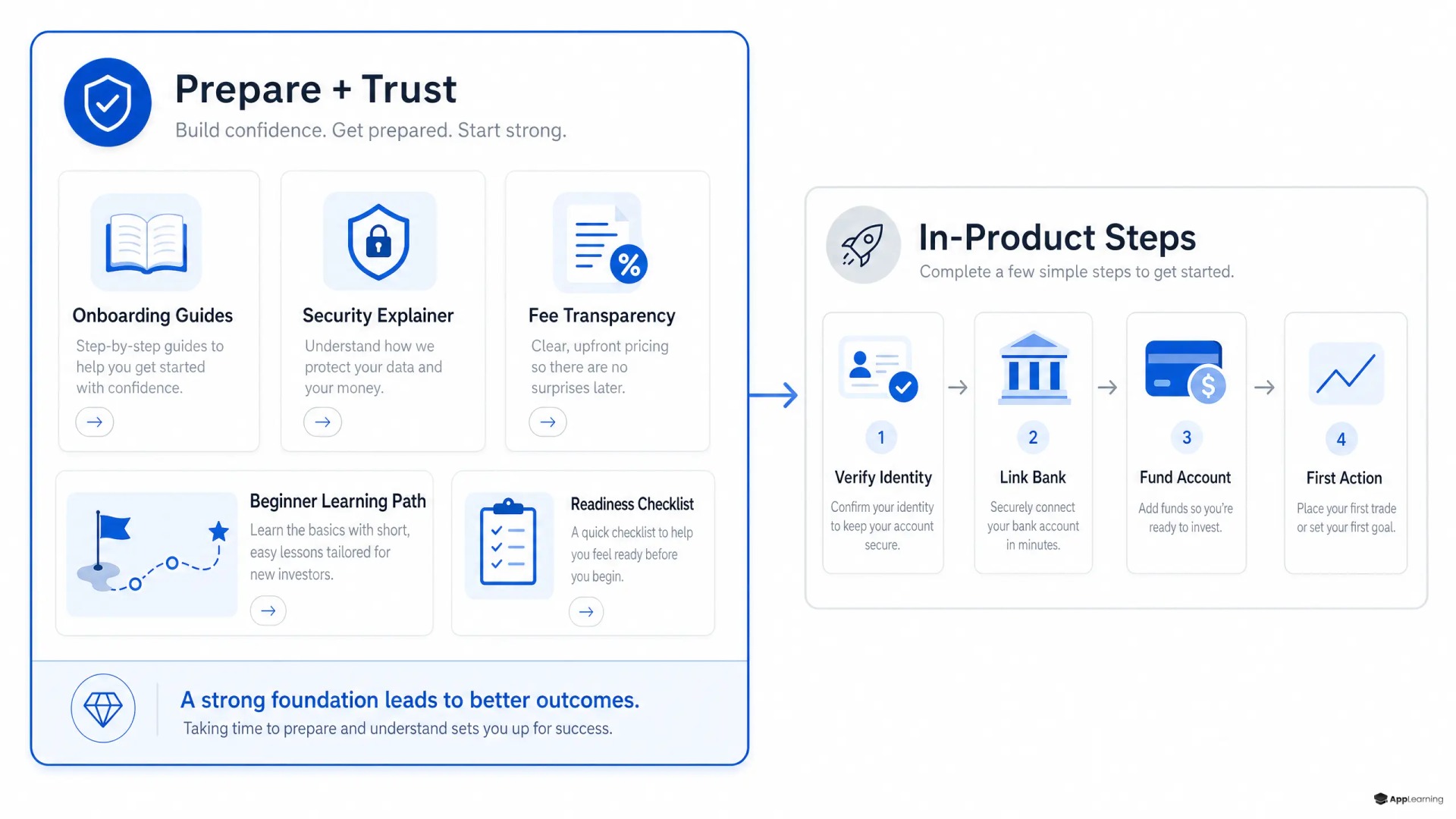
Great onboarding in a hard crypto product has two layers. The operational layer gets the account created. The educational layer makes the next action understandable. If one layer is missing, users either get blocked by friction or move forward without conviction.
- Pre-entry orientation that explains what the user will need, how long it may take, and why the steps exist.
- Contextual explanations that appear near the point of friction, not in a remote help center.
- Risk checkpoints that teach the concept before asking the user to accept the risk.
- Product translation that turns technical features into concrete user jobs.
- Small confidence loops that combine learning, action, feedback, and visible progress.
- Recovery paths that let users pause, learn, return, and continue without starting over.
This is not about adding a course on top of a product. It is about placing the right explanation at the right moment. A user who is choosing a recurring buy plan needs a different lesson than a user setting up self-custody. A user who failed a knowledge check needs a different path than a user who already understands crypto and wants speed.
An education layer changes the sequence
An education layer changes onboarding because it starts earlier. It can sit before signup, inside the app, inside the web journey, in lifecycle emails, and at specific moments of friction. It gives users a safe place to learn before the product asks them to decide.
The hub should not feel like a generic blog or a compliance archive. It should feel like part of the product. App-Learning’s product layer supports short lessons, quizzes, certificates, and gamified mechanics, which are useful when the goal is not just to publish content but to move users from curiosity to confident action.
In practice, the curriculum should map to product moments. A beginner path prepares the first buy. A wallet path prepares withdrawal. A recurring buy path prepares savings-plan activation. A scam-awareness path prepares higher-risk transfer moments. A market-basics path prepares users for volatility without pushing them into speculation.
This is also an operating advantage. In the Invity Academy case, 19 lessons and 6 quizzes were embedded in the app within eight weeks. The important point is not the lesson count. It is the system. Education became part of the user journey rather than a side project owned by a busy content team.
Good to know
Should crypto education happen before signup or inside onboarding?
Both. Pre-signup education builds readiness before the user hits friction, while in-product education gives contextual help when a decision is required.
Does adding education make onboarding slower?
It can if it is built like a long course. It helps when lessons are short, contextual, and tied to a concrete product action.
Which onboarding metrics matter beyond completion rate?
Track lesson starts, lesson completion, quiz accuracy, repeated knowledge gaps, support volume, first transaction timing, advanced feature adoption, and retention after first use.
Can education replace compliance checks or risk assessments?
No. Education prepares users, while regulated checks and assessments still need to do their own job. The two should support each other without becoming the same thing.
Crypto onboarding needs segmentation
A single beginner flow cannot serve every crypto user well. The audience is too mixed. Some users need first-principles education. Some need reassurance about the company. Some need security guidance. Some know crypto well and only need product-specific context.
A stronger onboarding system uses segmentation without making the product feel fragmented. The first screen can ask what the user wants to do or what they already understand. The education layer can then assign a path, skip known basics, and surface lessons only when they matter.
- Complete beginners need simple concepts, examples, and one safe first action.
- Skeptical users need trust signals, risk clarity, and explanations of safeguards.
- Experienced crypto users need fast paths with product-specific details.
- Users approaching self-custody need security education before withdrawal.
- Users considering recurring buys need habit logic, volatility context, and expectation setting.
Segmentation also protects growth metrics from false averages. If beginners drop at wallet setup, that is not the same problem as experienced users dropping at bank linking. If skeptical users read security content before funding, that may be a healthy delay, not weak intent.
Build user confidence before the hardest step.
DiscussThe operating model decides whether education scales
Most crypto and bitcoin product teams know education matters. The constraint is execution. Product, compliance, growth, support, and local market teams all have input. Content must be accurate, updated, localized, measured, and tied to product releases. A static academy breaks quickly when the product changes.
This is where an educational layer needs its own operating model. It needs source material from internal experts, clear learning objectives, compliance review, modular content, localization workflows, and analytics. App-Learning’s platform can track completion rates, drop-off points, critical quiz questions, and learning time, which helps teams see whether users are actually building understanding or only clicking through.
For crypto products, the educational layer should be treated as activation infrastructure. App-Learning’s Simple Bitcoin Academy reports more than 175,000 downloads across more than 180 countries, which shows the demand for structured crypto learning when the experience is simple, mobile, and action-oriented. The same logic can sit inside a fintech product: small lessons, clear checks, timely prompts, and a route from learning to safe action.
Complex crypto and bitcoin onboarding does not fail only because a form is too long. It fails when the product asks for belief before it has created understanding. The best teams will still reduce friction, improve verification, and simplify flows. But they will also prepare the user before the hardest step arrives. In crypto, confidence is not a soft metric. It is the bridge between curiosity, activation, and long-term use.